

Starry grouper (Epinephelus labriformis)
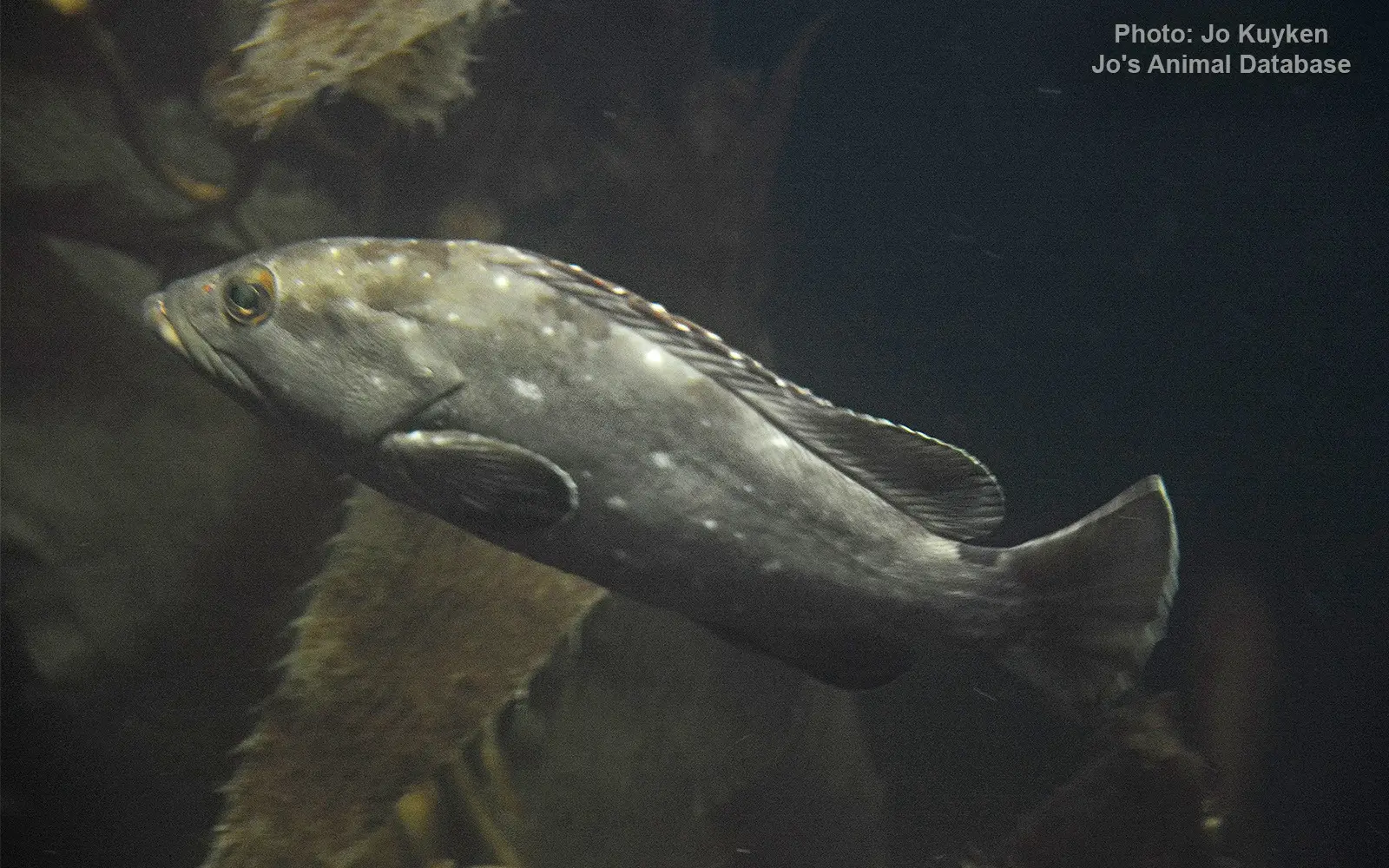
Image source: Jo's Animal Database
General data
- Main name: Starry grouper
- Local names: Flag cabrilla, Flag cabrilla
- Climates: Tropical, Subtropical
- Habitat: Saltwater
- Native: North America, South America
- Distribution: Pacific Ocean
Classification
- Genus: Epinephelus - Cloudy groupers
- Family: Epinephelidae - Groupers
- Order: Perciformes - Perches
- Class: Actinopteri - Ray-finned fishes
- Superclass: Osteichthyes - Bony fishes

The Starry grouper (Epinephelus labriformis), also known as the Flag cabrilla, is a marine ray-finned fish belonging to the grouper subfamily Epinephelinae within the family Serranidae. This family also includes sea basses and anthias. The species is native to the tropical eastern Pacific Ocean, where it inhabits rocky reefs and coastal marine environments.
Epinephelus labriformis has a robust and laterally compressed body with a rounded tail fin and a relatively deep profile typical of many reef-associated groupers. Its body depth fits approximately 2.7 to 3.1 times into the standard length. The species has a flat area between the eyes, while the preopercle is rounded and finely serrated.
The coloration of the Starry grouper is especially distinctive. The body and head are generally olive green with scattered irregular white spots and blotches, giving the fish its common name. Red-brown markings occur on the head and front portion of the body, while a dark saddle-like blotch is visible on the upper part of the caudal peduncle near the tail. The edges of the dorsal, anal, caudal, and pectoral fins often display reddish coloration.
The dorsal fin contains 11 spines and 16–18 soft rays, while the anal fin has 3 spines and 8 soft rays. Adults can reach a maximum total length of about 60 cm, although most individuals are smaller.
The Starry grouper is distributed throughout the tropical eastern Pacific Ocean, ranging from Mexico southward to Peru. Its range also includes several offshore island groups such as the Galápagos Islands, Cocos Island, Malpelo Island, and the Revillagigedo Islands.
This species typically inhabits rocky reefs, reef slopes, and coastal marine habitats where it shelters among rocks and crevices during the day. Juveniles are often found in shallower coastal waters, while larger adults may occur at greater depths along reef structures.
Like other groupers, the Starry grouper is a carnivorous predator feeding mainly on fishes, crustaceans, and other small marine animals. It is generally a solitary species that hunts by ambushing prey from cover.
The species is locally important to artisanal and small-scale commercial fisheries throughout parts of its range. It is also valued by recreational anglers due to its attractive coloration and fighting ability.
Healthy reef ecosystems are important for maintaining stable populations of Epinephelus labriformis. Habitat degradation, coastal pollution, and overfishing may threaten some local populations in heavily impacted regions.