


Longtooth grouper (Epinephelus bruneus)
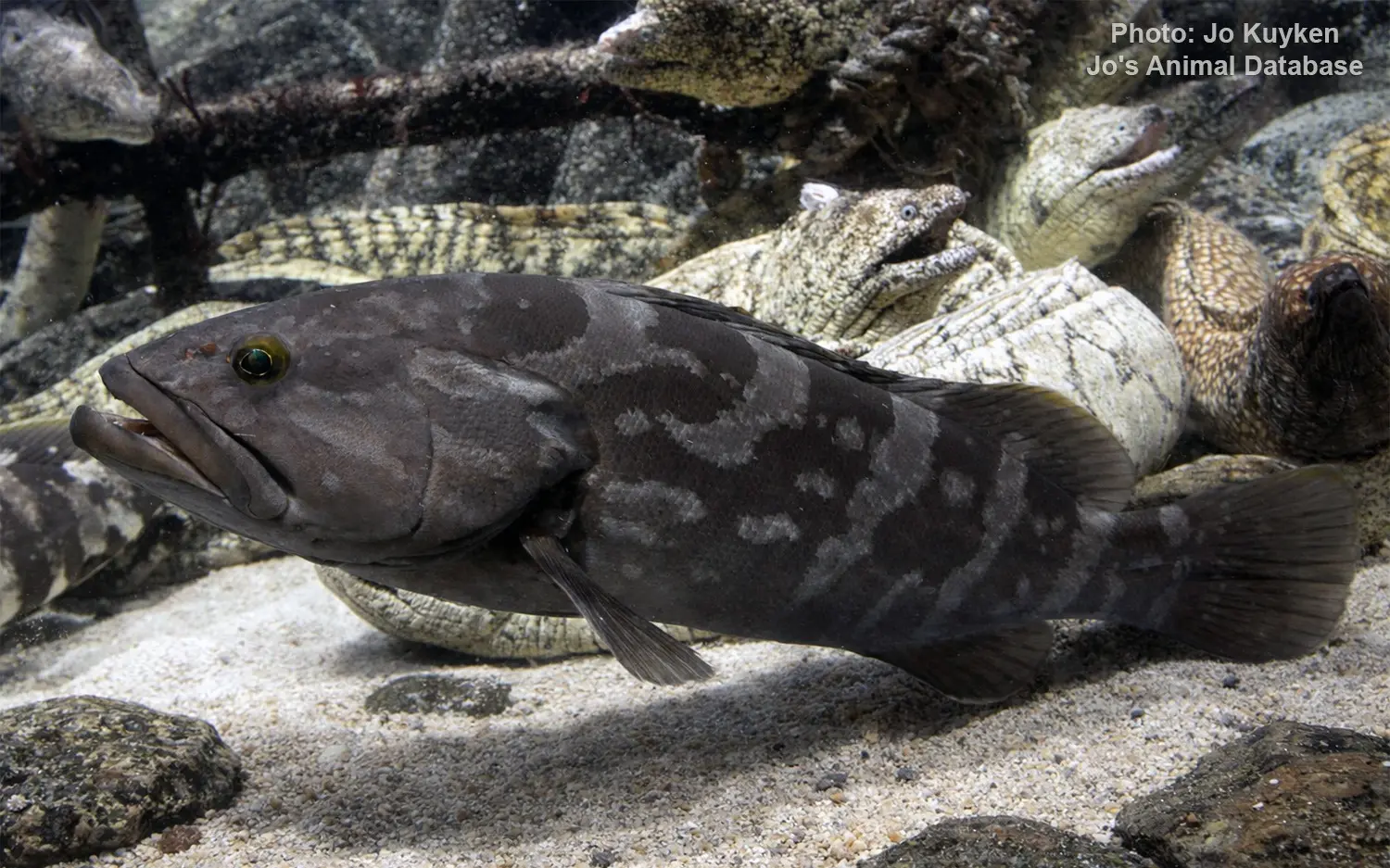
Image source: Jo's Animal Database
General data
- Main name: Longtooth grouper
- Local names: Mud grouper, Kelp grouper, Jabari, Kue
- Climates: Tropical, Subtropical
- Habitat: Saltwater
- Native: Asia
- Distribution: Pacific Ocean, South China Sea, East China Sea, Sea of Japan (East Sea)
Classification
- Genus: Epinephelus - Cloudy groupers
- Family: Epinephelidae - Groupers
- Order: Perciformes - Perches
- Class: Actinopteri - Ray-finned fishes
- Superclass: Osteichthyes - Bony fishes

Description
Epinephelus bruneus, commonly known as the longtooth grouper, kelp grouper or jabari is a species of marine ray-finned fish, a grouper from the subfamily Epinephelinae which is part of the family Serranidae, which also includes the anthias and sea basses.
It is found in northwest Pacific in eastern Asia, where the species is known by the traditional name "Kue".
Longtooth grouper has an elongate body which has a standard length which is 3.0 to 3.6 times its depth. The dorsal profile of the head between the eyes is convex. The preopercle has an angle where the serrations are notably enlarged. There is a small spine on the upper edge of the gill cover and this upper edge is convex.
The dorsal fin contains 11 spines and 13-15 soft rays while the anal fin has 3 spines and 8 soft rays.
It has 64-72 scales in its lateral line.
The larger adults are dark greyish brown in colour, and may be marked with faint blotches on their backs, although these may be absent. They also have a covering of small grey spots on their bodies which form short longitudinal lines and creating a mottled pattern.
The lower margin of the anal fin and the lower corner of caudal fin have white edges.
The juveniles are pale yellowish brown in colour, with 6 irregular, diagonal dark bars within which there are irregular pale spots. The first of these bars extends from nape to eye and the last is on the caudal peduncle. There are 3 dark brown bands which radiate from lower part of eye and some juveniles have greenish yellow membranes between the rearmost spines of the dorsal fin.
The maximum published total length for this species is 136 centimetres (54 in), although the most common length is around 60 centimetres (24 in), and the maximum recorded weight is 33 kilograms (73 lb).
Epinephelus bruneus is found in the Western Pacific Ocean where it occurs from southern Japan and Taiwan and along the coast of Asia from southern Korea to Hainan and Hong Kong in southern China.