
European perch (Perca fluviatilis)
General data
- Main name: European perch
- Local names: Eurasian perch
- Climates: Subtropical, Temperate, Continental, Subpolar, Mountain
- Habitat: Freshwater
- Native: Europe, Asia
- Introduced: Africa, Australia & Oceania
- Distribution: Danube, Ebro, Caspian Sea, Volga, Ural, Struma (Strymonas), View all... Vardar (Axios), Nestos, Kuban, Rhine, Glomma, Scheldt, Ems, Rhone, Dniester, Dnieper, Southern Bug, Charente, Yenisey, Lake Baikal, Lake Volvi, Amu Darya, Vistula, Kolyma , River Ob, Pechora, Oder, Tiber, Loire, Murray River, River Thames, Kemijoki, Daugava (Western Dvina), Narva, Seine, Garonne, Mezen, Northern Dvina, Neman (Nemunas), Kamchiya, Bann, Gudena, Lielupe, Venta, Gauja, Trent, Great Ouse, River Clyde, River Nene, Weser, River Eden (Cumbria), River Ribble, River Tyne, River Tees, River Taff, River Ely, River Parrett, Ume river, Pite River, Kokemaenjoki, Mynajoki River, Sulak River, Lake Skadar, Meuse (Maas), Elbe, Aura River (Aurajoki), Drin, Neretva, Mosse River (Mosseelva), Tovdalselva, Po River, Bojana, Vrljika
Classification
- Genus: Perca - Perches
- Family: Percidae - Perches
- Order: Perciformes - Perches
- Class: Actinopteri - Ray-finned fishes
- Superclass: Osteichthyes - Bony fishes

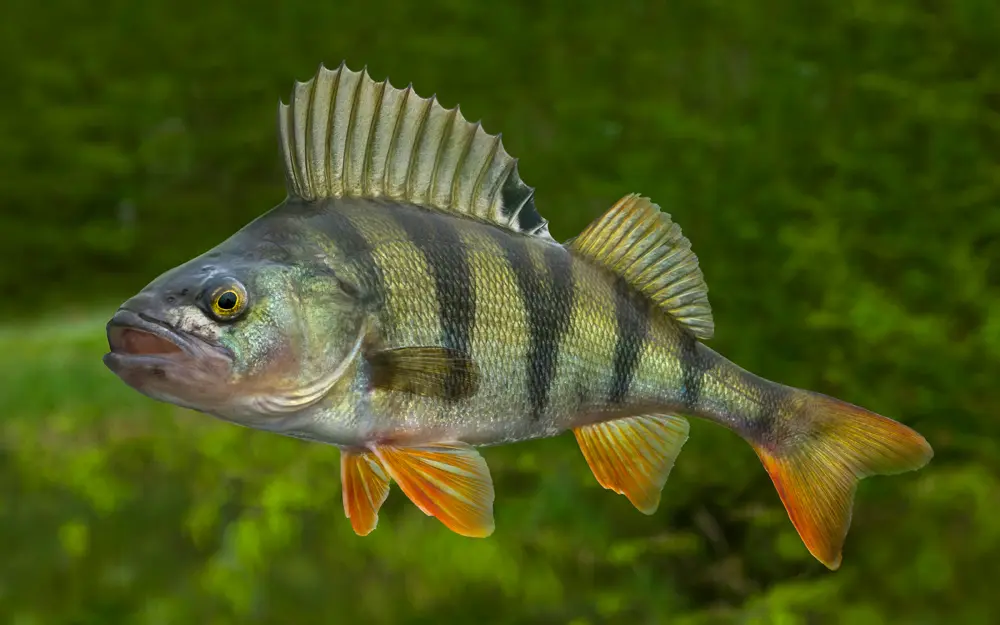
European perch (Perca fluviatilis) is one of the most recognizable freshwater fish in Europe and belongs to the family Percidae. It is easily identified by its striking coloration and distinctive body pattern. The body is typically greenish to olive in color with five to eight dark vertical bars along the sides. These bands provide camouflage among aquatic plants and submerged structures. One of the most distinctive features of the species is its bright red pelvic, anal, and caudal fins, which strongly contrast with the darker body color.
The body of the European perch is laterally compressed and equipped with two dorsal fins. The first dorsal fin is supported by strong spines which serve as protection against predators, while the second dorsal fin contains soft rays and helps stabilize the fish while swimming. As perch grow larger and older, many develop a distinct hump between the head and the dorsal fin, giving large specimens a deeper and more robust body profile.
European perch can vary greatly in size depending on the body of water and food availability. They may live for up to about 22 years, and older individuals are often much larger than average. The maximum recorded length is around 60 cm. The British record weight is 2.806 kg, although perch generally grow larger in mainland Europe than in Britain. The official all-tackle world record recognized by the International Game Fish Association (IGFA) is 2.9 kg, caught in Finland on September 4, 2010. An exceptionally large specimen weighing 3.75 kg and measuring 58 cm was caught in the River Meuse in the Netherlands in 2010.
In areas with slightly brackish water, such as parts of the Baltic Sea, perch can grow especially large. Due to the relatively low salinity in the Baltic, particularly around the Finnish archipelago and the Bothnian Sea, many freshwater fish thrive there. European perch benefit from abundant prey such as Baltic herring, which allows them to reach impressive sizes.
The natural distribution of the European perch includes most freshwater basins across Europe, with the exception of the Iberian Peninsula. Its range extends far to the east across northern Asia, reaching the Kolyma River in Siberia. Although primarily a freshwater species, it also occurs in some brackish waters of the Baltic Sea.
This species typically inhabits slow-flowing rivers, lakes, ponds, and reservoirs. It prefers waters with moderate depth and good light penetration where aquatic vegetation and underwater structures provide shelter and feeding opportunities. European perch are particularly abundant in relatively shallow lakes and in lakes with clear water. They are less common in very deep lakes or waters with low light penetration. Although perch usually avoid very cold or fast-flowing waters, some individuals may enter such habitats temporarily, but they generally do not reproduce successfully there.
European perch has been widely introduced outside its native range, sometimes with negative ecological consequences. In certain regions these introductions have affected native fish populations. For example, in Australia, introduced European perch have been linked to the decline of the endangered Macquarie perch through competition and predation.
European perch is a very popular species among recreational anglers throughout Europe. It is valued both for its willingness to bite and for its excellent table quality. Perch are predatory fish that feed on a wide variety of prey including small fish, insects, crustaceans, worms, and larvae.
They can be caught using many fishing techniques. Spinning with artificial lures is one of the most effective methods, especially with small soft plastic shads, jig heads, spinners, spoons, and small crankbaits. Perch often gather in schools, so once an angler catches one fish there are often several more nearby.
Float fishing with natural bait such as worms, maggots, or small baitfish is also a traditional and productive technique, especially in lakes, canals, and slow rivers. Modern finesse methods such as drop-shot rigs and light jigging are widely used by anglers targeting larger perch in deeper water.
Seasonal behavior strongly influences fishing success. During spring and autumn, perch are often very active and hunt in schools. In summer, they may remain deeper during the day and feed more actively during early morning and evening hours. In winter, perch frequently gather in dense schools in deeper water where they can still be caught using slow jigging techniques.
Smaller perch typically form large schools, while larger specimens tend to be solitary or occur in small groups. Because of its wide distribution, distinctive appearance, and willingness to strike many types of bait and lures, the European perch remains one of the most important and beloved freshwater sport fish in Europe.