
Snubnose grouper (Epinephelus macrospilos)
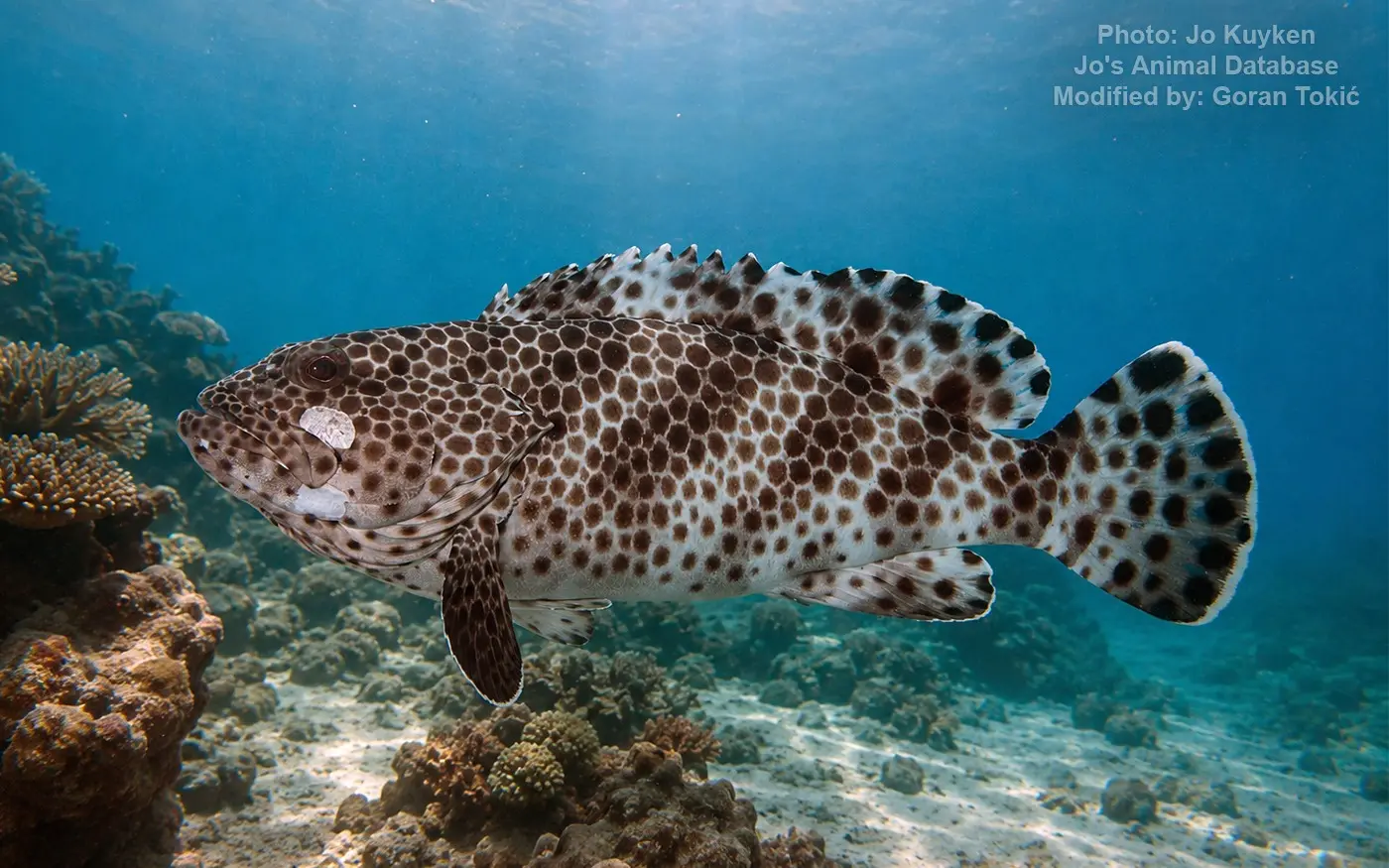
Image source: Jo's Animal Database
General data
- Main name: Snubnose grouper
- Local names: Snubnose rockcod, Large-spotted rockcod
- Climates: Tropical
- Habitat: Saltwater
- Native: Africa, Asia, Australia & Oceania
- Distribution: Indian ocean
Classification
- Genus: Epinephelus - Cloudy groupers
- Family: Epinephelidae - Groupers
- Order: Perciformes - Perches
- Class: Actinopteri - Ray-finned fishes
- Superclass: Osteichthyes - Bony fishes

The Snubnose grouper (Epinephelus macrospilos) is a small to medium-sized reef fish species belonging to the grouper family Serranidae. This colorful Indo-Pacific species is known for its compact body, rounded snout, and attractive patterning, which helps it blend into reef and seaweed habitats.
This species is distributed widely across the Indo-Pacific region, ranging from the eastern coast of Africa to the central Pacific Ocean. It occurs around coral reefs, lagoons, rocky reefs, and seaweed-covered reef areas, where it usually inhabits shallow to moderately deep coastal waters down to about 44 meters.
The Snubnose grouper is a predatory fish that mainly feeds on small crustaceans, fishes, and cephalopods such as squid and cuttlefish. Like many groupers, it is an ambush predator that waits among rocks or reef structures before quickly striking prey.
Epinephelus macrospilos reaches a maximum recorded length of around 43 cm and can weigh up to approximately 2 kg. Most individuals encountered by divers and anglers are considerably smaller.
The species can usually be recognized by its stout body, relatively short blunt snout, and distinctive coloration. Individuals commonly display brownish to reddish tones with darker blotches or irregular markings that provide excellent camouflage among reefs and algae-covered substrates.
Snubnose groupers are generally solitary fish and are most active around reef structures where they can find shelter and hunting opportunities. Juveniles are often found in protected lagoon habitats, while adults tend to occupy deeper reef environments.
Although not among the largest commercially important groupers, the species is occasionally caught by artisanal fisheries throughout its range. It is also sometimes encountered in the aquarium trade due to its attractive appearance.
Like many reef-associated fishes, the Snubnose grouper depends heavily on healthy coral reef ecosystems. Habitat degradation, reef destruction, and overfishing may negatively affect local populations in some regions.
Common names for Epinephelus macrospilos include Snubnose grouper in English and Mero alfombrado in Spanish.