

Australian ghostshark (Callorhinchus milii)
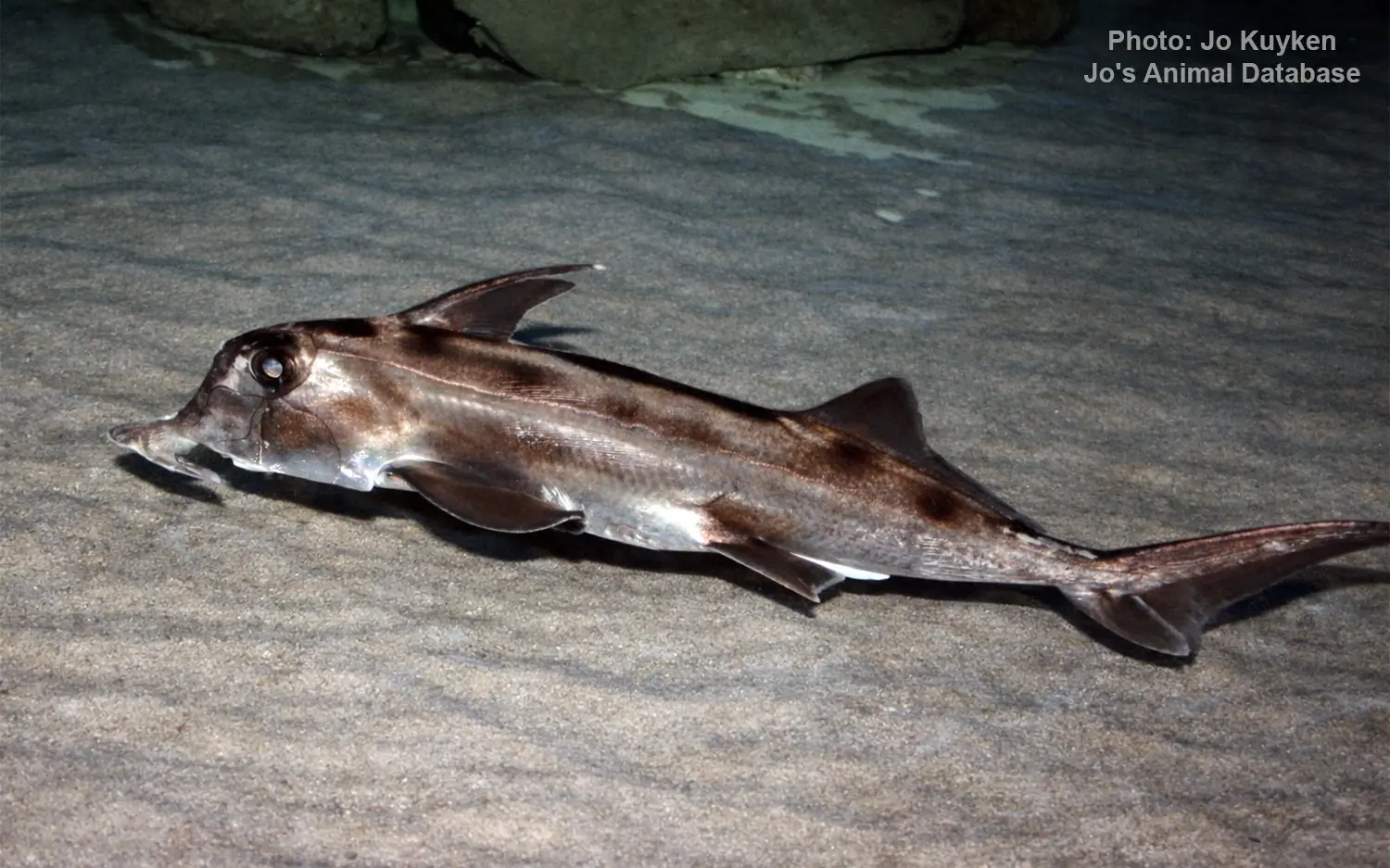
Image source: Jo's Animal Database
General data
- Main name: Australian ghostshark
- Local names: Ghost shark, Elephant shark, Makorepe, Plough-nose chimaera, Elephant fish
- Climates: Subtropical
- Habitat: Saltwater
- Native: Australia & Oceania
- Distribution: Pacific Ocean
Classification
- Genus: Callorhinchus - Callorhinchus
- Family: Callorhinchidae - Plownose chimaeras
- Order: Chimaeriformes - Chimaeras
- Class: Holocephali - Chimaeras
- Superclass: Chondrichthyes - Cartilaginous fishes

Description
The Australian ghostshark (Callorhinchus milii) is a cartilaginous fish (Chondrichthyes) belonging to the subclass Holocephali (chimaera). Alternative names include elephant shark, makorepe (in Māori), whitefish, plough-nose chimaera, or elephant fish.
It is found off southern Australia, including Tasmania, and south of East Cape and Kaipara Harbour in New Zealand, at depths of 0–200 m (0–656 ft).
Despite several of its names, it is not a shark, but a member of a closely related group.
The fish is silvery in colour with iridescent reflections and dark, variable markings on the sides. Males mature at 50 cm (1.6 ft) and females at 70 cm (2.3 ft), and the maximum length head to tail is 1.5 m (4.9 ft).
It has an elongated body, which is smooth and torpedo shaped, with two widely separated, triangular dorsal fins.
They use their hoe-shaped snouts to probe the ocean bottom for invertebrates and small fishes.
From spring to autumn, adults migrate inshore to estuaries and bays and females lay their eggs on sandy or muddy substrates.
Maximum age is estimated to be 15 years.
This fish has three cone pigments for colour vision (like humans). Its dorsal fin has a very sharp spine. The spine has been reputed to be venomous, but no serious injuries have yet been reported.
At present this species is considered native to the waters of southern Australia and New Zealand. However, it has been hypothesized that the New Zealand population and the Australian population may actually be separate species.[
In South Australia, they are caught by some recreational fishers in inshore waters during autumn and winter, typically from surf beaches or sheltered beaches.
In New Zealand, Australian ghostsharks are exploited commercially, particularly during spring and summer when they migrate into shallow coastal waters. In Australia, they are caught by southern shark gillnet fishery, particularly in Bass Strait and south-east Tasmania, though this fishery targets the gummy shark, Mustelus antarcticus, and will sometimes discard ghostsharks due to the considerably lower price they fetch at market.
They are also a popular target of recreational fishers in Westernport Bay, Victoria and in the inshore waters of south-east Tasmania.