
Cape elephantfish (Callorhinchus capensis)
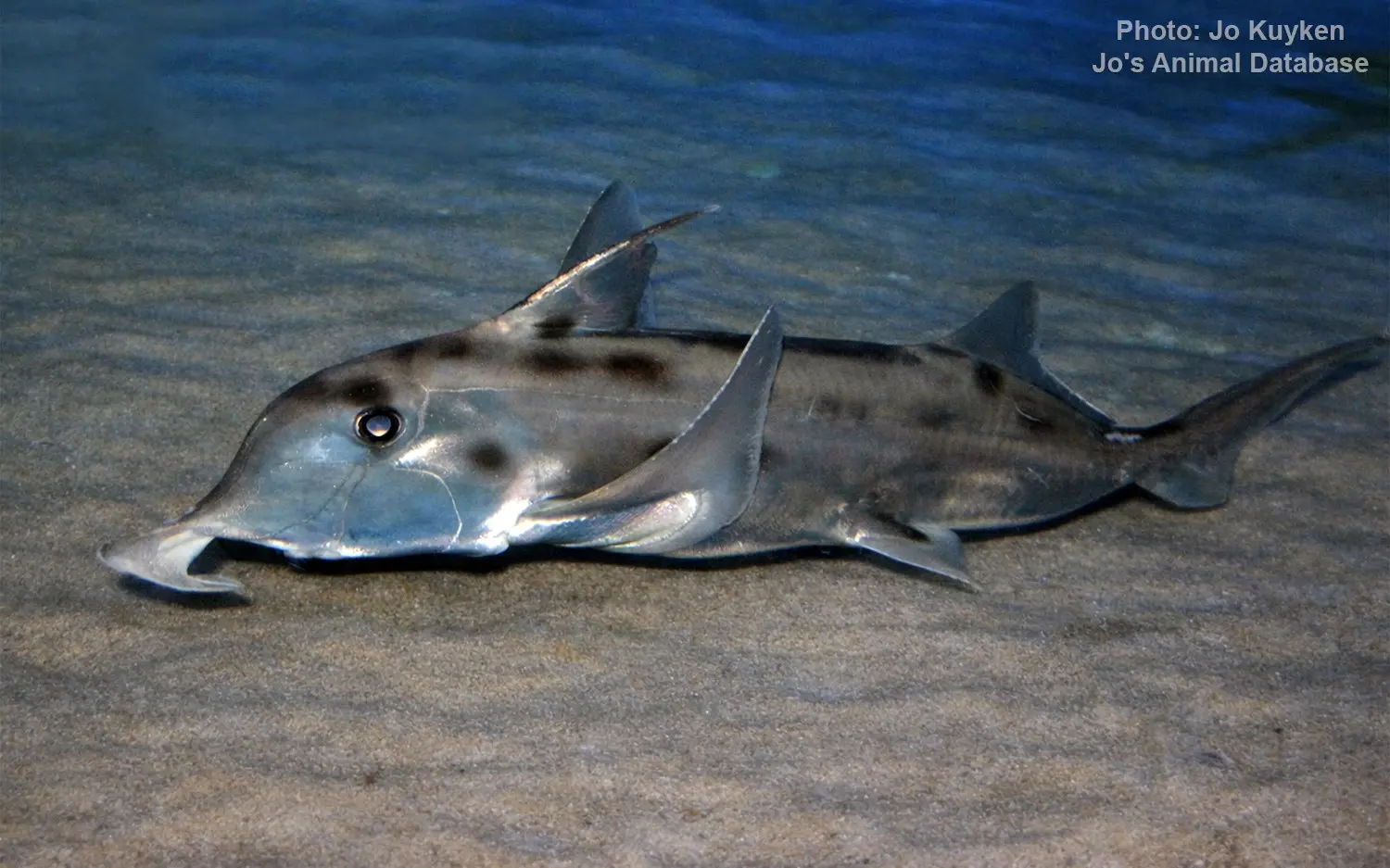
Image source: Jo's Animal Database
General data
- Main name: Cape elephantfish
- Local names: St. Joseph
- Climates: Subtropical
- Habitat: Saltwater
- Native: Africa
- Distribution: Pacific Ocean, Indian ocean
Classification
- Genus: Callorhinchus - Callorhinchus
- Family: Callorhinchidae - Plownose chimaeras
- Order: Chimaeriformes - Chimaeras
- Class: Holocephali - Chimaeras
- Superclass: Chondrichthyes - Cartilaginous fishes

Description
Cape elephantfish (Callorhinchus capensis) is a species of chimaera, a cartilaginous fish related to sharks and rays. It belongs to the genus Callorhinchus and is native to the waters surrounding South Africa. Although sometimes called the St Joseph shark, it is not a true shark.
Adults range from about 45 to 120 cm in length and usually weigh between 3 and 5 kg, with females generally larger than males.
Their body is silver to bronze, often with a yellowish hue, and a dark band runs along the back. They have two widely separated dorsal fins, the first bearing a long venomous spine. The tail is heterocercal, and the large pectoral fins allow slow swimming close to the seafloor, an adaptation to a deep, bottom-dwelling lifestyle.
The most distinctive feature is the elongated, flattened proboscis projecting from the head, used to search for food in soft sediments.
The eyes have vertical pupils, and the upper front teeth are small and pointed compared to related species.
Males develop claspers and specialized grasping organs used during mating, as well as a flexible frontal projection covered in hardened denticles. Females develop large ovaries and a nidamental gland that produces leathery, oval egg cases with a frilled edge.
Cape elephantfish live on continental shelves around South Africa, including areas off Namibia and KwaZulu-Natal. They inhabit cold, murky coastal waters with soft bottoms, often in sheltered bays. Juveniles stay closer to shore, while adults occur farther offshore and in deeper water. The species lives exclusively in marine environments.