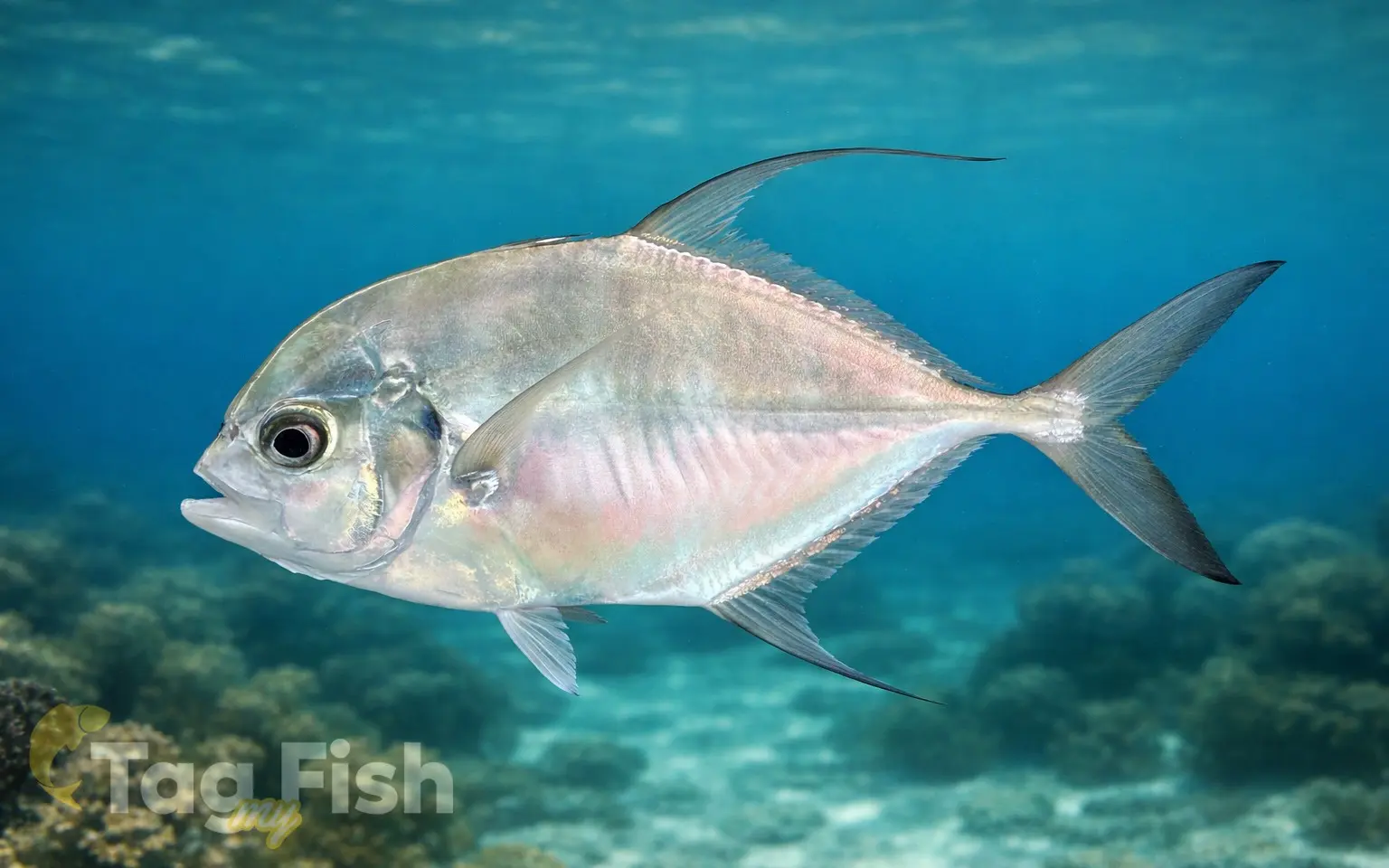


Longfin trevally (Atropus armatus)
Image source: Created by ChatGPT
General data
- Main name: Longfin trevally
- Climates: Tropical, Subtropical
- Habitat: Saltwater
- Native: Africa, Asia
- Distribution: Bay of Bengal, Pacific Ocean, Red sea, Indian ocean
Classification
- Genus: Atropus - Atropus
- Family: Carangidae - Jacks
- Order: Carangiformes - Jacks
- Class: Actinopteri - Ray-finned fishes
- Superclass: Osteichthyes - Bony fishes

Longfin trevally (Atropus armatus) is an inshore marine fish belonging to the jack family (Carangidae), widely recognized for its distinctive elongated fins and streamlined, powerful body. It inhabits coastal tropical and subtropical waters and is most often associated with reefs and shallow bays.
Description: The longfin trevally has a deep, strongly compressed body typical of jacks, reaching up to 57 cm in length and around 3.5 kg in weight. It is easily identified by its highly elongated dorsal and anal fin lobes, with mature individuals—especially males—developing filament-like extensions on the dorsal fin rays. Another key feature is its scaleless breast, a useful diagnostic trait. The head profile is steep, and the species has a deeply forked tail suited for active swimming.
Its coloration is generally greyish-blue on the upper body, fading to silvery white on the belly. Juveniles often display six dark vertical bars along the sides, while all individuals typically have a distinct dark blotch on the upper margin of the gill cover. The fins vary from pale to blackish, with the pelvic fins often darker and edged in white.
Distribution: This species is widely distributed across the Indo-Pacific region. It ranges from South Africa in the west, including the coasts of East Africa and Madagascar, through the Red Sea and Gulf of Oman, across India and Southeast Asia, and extends eastward to Japan. It is commonly found in coastal environments throughout this range.
Habitat: The longfin trevally primarily inhabits inshore coastal waters and is rarely found far offshore. It is a pelagic predator that occupies both upper and lower parts of the water column. The species is most frequently associated with rocky and coral reefs, where it patrols reef edges either alone or in small groups. It is also common in shallow sandy bays and lagoons, while juveniles often utilize estuaries as nursery habitats.
Biology: A carnivorous species, the longfin trevally feeds on small fish, cephalopods such as squid, and crustaceans including crabs and mantis shrimp. Its well-developed gill rakers may also assist in filtering small organisms. Sexual maturity is reached at around 21–22 cm in length.
Fishery: Although not a major commercial species, the longfin trevally is occasionally caught and sold locally. It is regarded as good table fish and is particularly appreciated in parts of Southeast Asia. Recreational anglers also catch it using bait, lures, or spearfishing methods.