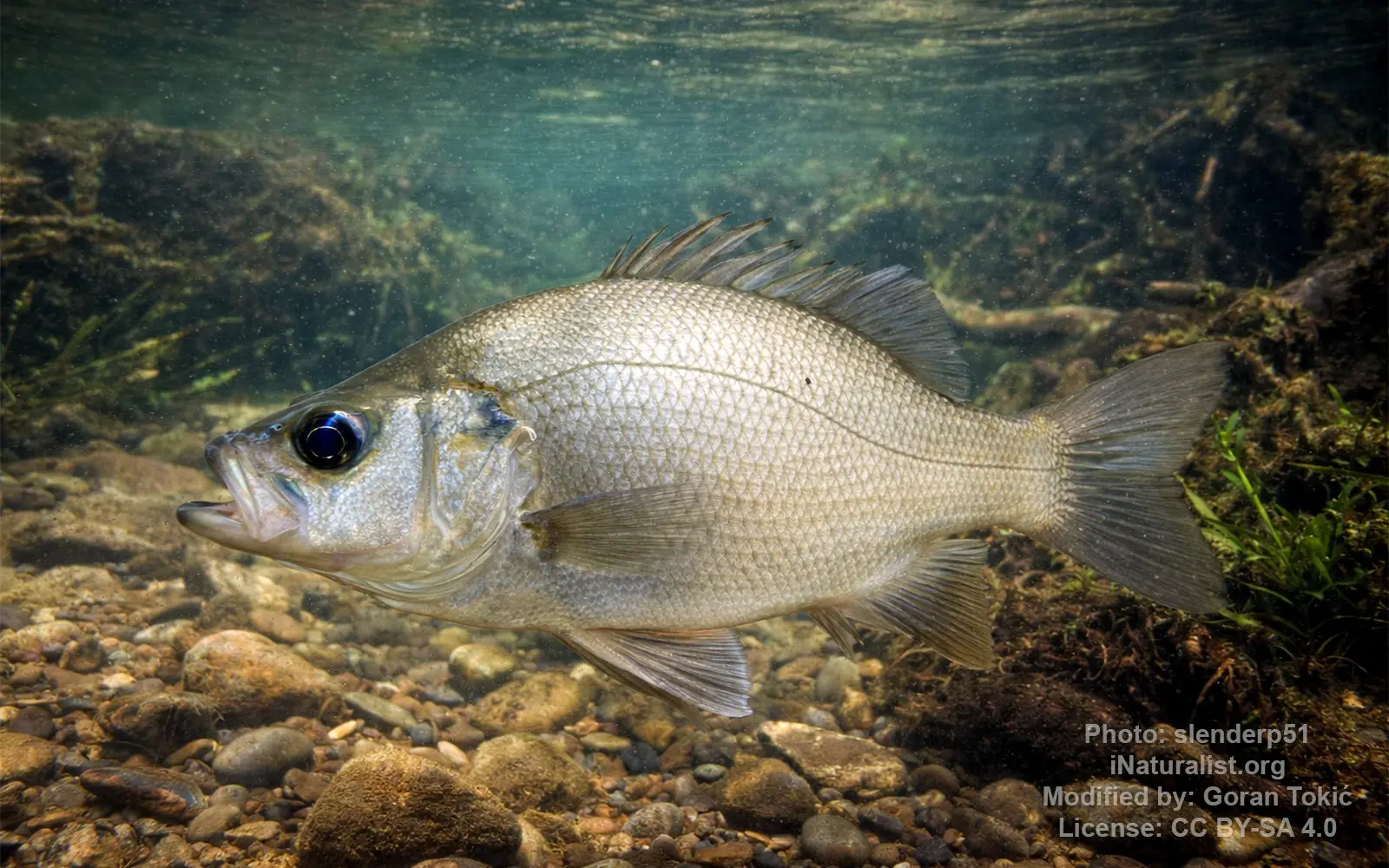


Estuary perch (Percalates colonorum)
Image source: slenderp51 | inaturalist.org
General data
- Main name: Estuary perch
- Climates: Subtropical, Temperate
- Habitat: Catadromous
- Native: Australia & Oceania
- Distribution: Murray River, Pacific Ocean
Classification
- Genus: Percalates - Percalates
- Family: Percalatidae - Australian basses
- Order: Centrarchiformes - Basses and sunfishes
- Class: Actinopteri - Ray-finned fishes
- Superclass: Osteichthyes - Bony fishes

Description
Percalates colonorum, commonly known as the estuary perch, is a large predatory ray-finned fish endemic to south-eastern Australia.
It closely resembles its sister species, the Australian bass (Percalates novemaculeata), but can be distinguished by its slightly more scooped forehead and a stronger association with brackish, tidally influenced waters.
The body is elongated and laterally compressed, with a large mouth adapted for feeding on fish, crustaceans, and other aquatic prey. Coloration is generally silvery to olive-brown, often darker along the back and paler on the sides. The estuary perch is one of the largest members of its genus.
While most individuals commonly reach lengths of around 40 cm, the species is reported to be capable of growing up to 75 cm in total length. Very large weights have occasionally been reported, although extreme values are generally considered unverified.
Females grow larger than males and mature at older ages, a trait shared with Australian bass.
This species inhabits coastal rivers, estuaries, streams, and coastal lakes of Victoria and New South Wales, preferring areas influenced by tidal movement.
Spawning occurs in winter and spring near estuary mouths, where semi-buoyant eggs are released and hatch within a few days. Estuary perch are notably long-lived, with recorded ages exceeding 40 years, an adaptation that allows populations to persist through long periods of poor recruitment. Once abundant and highly regarded as a sport fish, the species has experienced a significant historical decline and is now subject to strict fishing regulations in much of its range.