


Sammara squirrelfish (Neoniphon sammara)
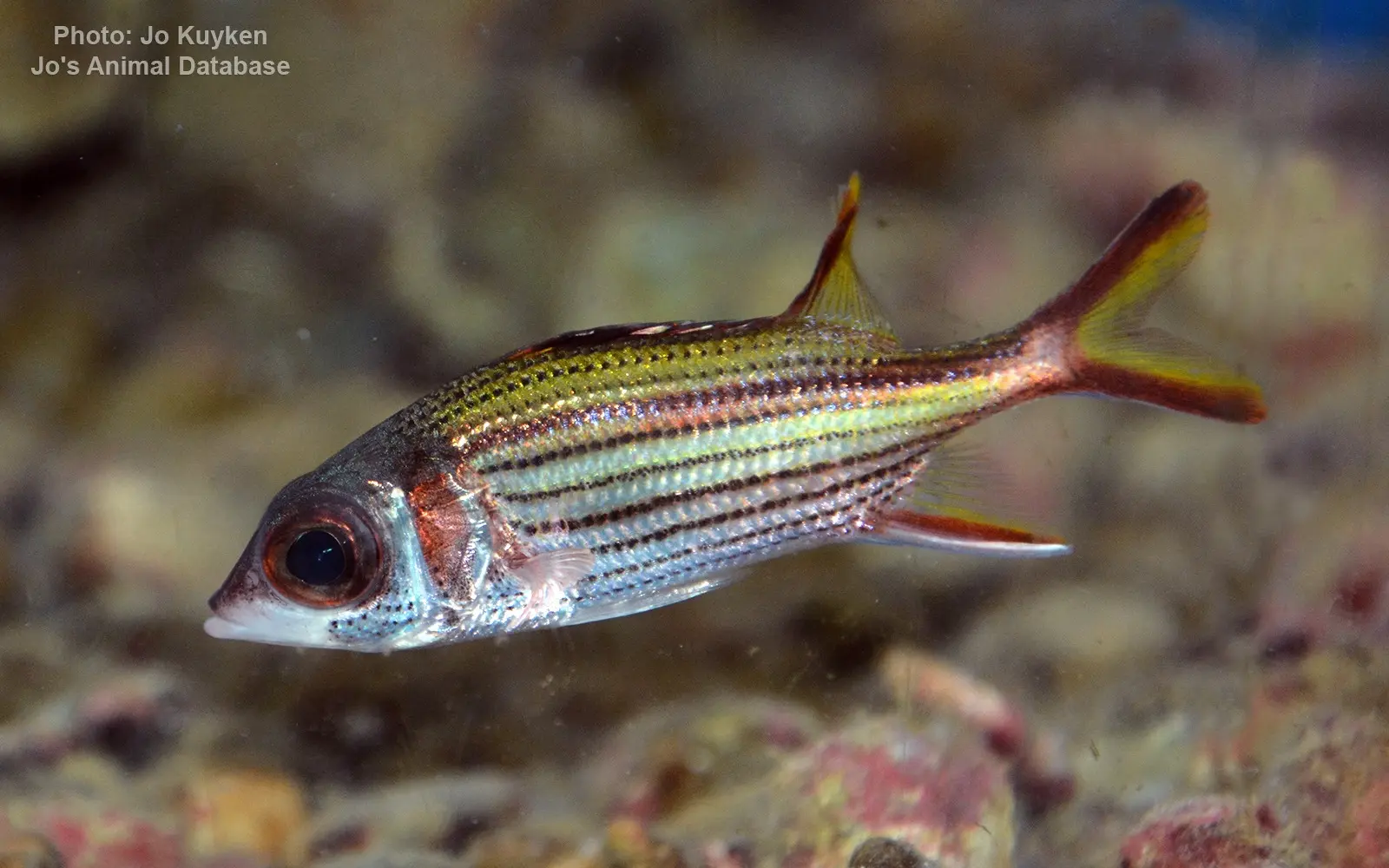
Image source: Jo's Animal Database
General data
- Main name: Sammara squirrelfish
- Local names: Slender squirrelfish, Blood-spot squirrelfish, Bloodspot squirrelfish, Blood-spot squirrel fish
- Climates: Tropical, Subtropical
- Habitat: Saltwater
- Native: Africa, Asia, Australia & Oceania
- Distribution: Red sea, Indian ocean, Pacific Ocean
Classification
- Genus: Neoniphon - Neoniphon
- Family: Holocentridae - Squirrelfishes
- Order: Holocentriformes - Squirrelfishes
- Class: Actinopteri - Ray-finned fishes
- Superclass: Osteichthyes - Bony fishes

Neoniphon sammara, commonly known as the sammara squirrelfish, is a marine ray-finned fish belonging to the family Holocentridae. This species is widely distributed across the tropical Indian Ocean and Pacific Ocean, ranging from the eastern coast of Africa to the Hawaiian Islands. It is also known by several other common names, including blood-spot squirrelfish, slender squirrelfish, spotfin squirrelfish, armed squirrelfish, and javelin squirrelfish.
This squirrelfish is easily recognized by its elongated body, large eyes adapted for nocturnal activity, and reddish coloration marked with pale or whitish spots. Like other members of the family Holocentridae, it is primarily active at night and spends much of the day hiding among reef structures.
Neoniphon sammara can reach a maximum total length of about 32 cm, although most individuals are typically around 23 cm long. Its body is laterally compressed and covered with rough ctenoid scales, while the head is relatively large with prominent eyes that enhance vision in low light. A distinctive feature of this species is the presence of a venomous spine on the preopercle, a defensive adaptation shared with closely related species such as Neoniphon opercularis. This spine can inflict painful wounds if the fish is handled carelessly.
The sammara squirrelfish is a nocturnal predator. During the night it leaves its daytime shelters to hunt small benthic animals. Its diet mainly consists of shrimps, small crabs, and small fishes. The species relies on its excellent night vision and lateral line system to detect prey in the darkness around coral reefs.
Neoniphon sammara inhabits a variety of shallow reef environments. It occurs on seagrass beds, reef flats, lagoons, and hard coral substrates, usually at depths between 0 and 46 meters. Individuals may live alone or form small groups, particularly in sheltered reef areas. Among species of the genus Neoniphon, this one is considered the most likely to occur in very shallow waters.
During daylight hours the fish typically hides among reef crevices or inside coral formations. It is frequently associated with Acropora corals, whose complex branching structure provides effective protection from predators. These coral colonies serve as daytime shelters where the fish remains largely inactive until nightfall.
Because of its wide distribution and stable populations, Neoniphon sammara is considered a common reef fish throughout much of the Indo-Pacific region. Although it has little commercial importance for fisheries, it is sometimes observed by divers and occasionally appears in the aquarium trade due to its striking coloration and characteristic squirrelfish appearance.