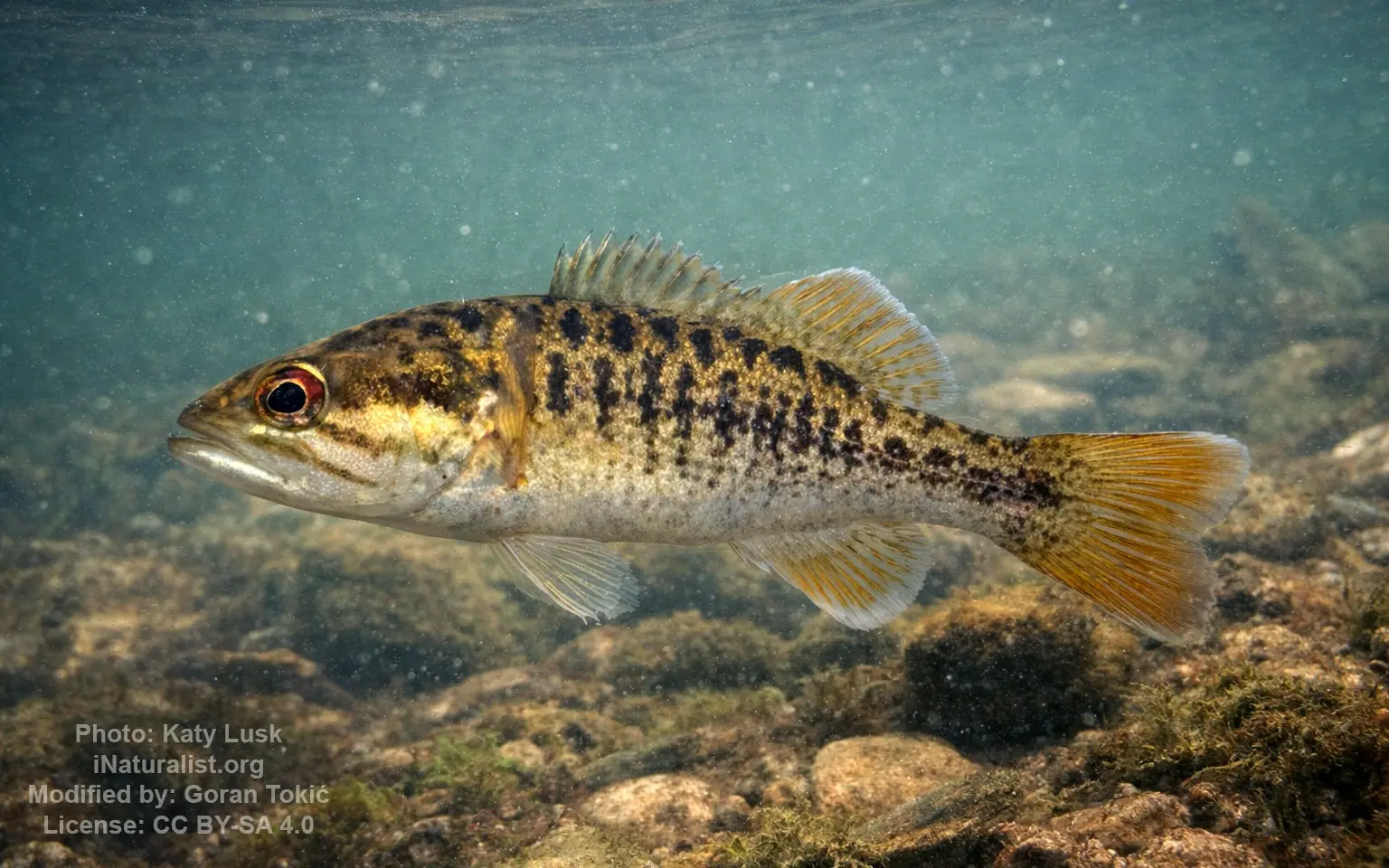


Redeye bass (Micropterus coosae)
Image source: Katy Lusk | inaturalist.org
General data
- Main name: Redeye bass
- Climates: Subtropical
- Habitat: Freshwater
- Native: North America
- Distribution: Mobile River, Altamaha River, Savannah river, Apalachicola River, Mississippi River, Sacramento River, View all... Santa Margarita River, San Joaquin River
Classification
- Genus: Micropterus - Black basses
- Family: Centrarchidae - Sunfishes
- Order: Centrarchiformes - Basses and sunfishes
- Class: Actinopteri - Ray-finned fishes
- Superclass: Osteichthyes - Bony fishes

Redeye bass are distinguished from other species of black basses due to a couple of subtle, but diagnostic features; the presence of a distinct silver-white crescent on the posterior (back) one-half of the eyeball, iridescent white, turquoise, or red on upper and lower margins of the caudal fin, a shallow emargination (notch) between the dorsal fins, and the absence of a dark mid-lateral (side) stripe along the body.
The upper and lower margins of the caudal fin are edged in white, a useful feature for separating redeye bass from both smallmouth bass (Micropterus dolomieu) and shoal bass (M. cataractae). Unique from all other black basses, redeye typically have three dark bars on the cheek. Most individuals (about 76%) have 0–6 vertical black blotches near the front of the body, followed by softer spots toward the back. The back and sides of the fish are generally olive to brown with darker brown mottling.
The redeye bass is a predatory fish that is endemic to the Coosa River system in the southeastern United States, including Georgia and Alabama. It can also be found in states such as Tennessee, Florida, South Carolina, and North Carolina.
Its occurrence in Georgia includes the Alabama River system, and Chattahoochee, Oconee, and Savannah Rivers. Sheed's Creek and Cohutta Creek are the only two streams in Tennessee in which this fish occurs naturally. While native to the area, the redeye bass is not known to occur within the Apalachicola River basin, where it is often mistaken as a shoal bass.
Redeye bass are limited to upland streams with canopy cover, cool water temperatures, vegetative cover, undercut banks, and rock ledges or large boulders. The species typically avoids impoundments and navigational pools, due to competition with the larger Alabama bass and largemouth bass. In 1962 and 1964, redeye bass were introduced in California to provide angling (hook on a line to catch fish) in streams dominated by native fishes not favored by anglers, examples being introductions into the Stanislaus River (Tuolumne County), Feather River (Butte County), Alder Creek (Sacramento County), and Santa Margarita River (San Diego County).
Now dominating in some California river ecosystems, the bass has eliminated native fishes.
Introduced redeye bass additionally pose a threat to California's endemic frogs and the California tiger salamander (Ambystoma californiense). In 1969 redeye bass raised in the California Department of Fish and Wildlife's (CDFG) Central Valley Hatchery were planted in Oroville Reservoir (Butte County), where they became established and hybridized with smallmouth and spotted bass. The redeye bass is established in the Sisquoc River within the Santa Maria River basin. Introduced Micropterus coosae have displaced native hardhead (Mylopharodon conocephalus) in the Cosumnes River.