


Snakeblenny (Lumpenus lampretaeformis)
Image source: Klaus Kevin Kristensen | inaturalist.org
General data
- Main name: Snakeblenny
- Climates: Subpolar
- Habitat: Saltwater
- Native: Europe, Asia, North America
- Distribution: North Sea, Norwegian sea, Atlantic Ocean
Classification
- Genus: Lumpenus - Lumpenus
- Family: Lumpenidae - Eel pricklebacks
- Order: Scorpaeniformes - Mail-cheeked fishes
- Class: Actinopteri - Ray-finned fishes
- Superclass: Osteichthyes - Bony fishes
The Snakeblenny (Lumpenus lampretaeformis) is an elongated, eel-like marine fish from the family Stichaeidae, found in cold and temperate waters of the North Atlantic. Its range extends from Spitsbergen southward along the Scandinavian coasts, the North Sea, and the southern Baltic Sea, as well as around the Faroe Islands, Iceland, and the southeastern coast of Greenland. On the western side of the Atlantic it occurs along the coasts of Greenland, Labrador, and Newfoundland, reaching as far south as Massachusetts Bay.
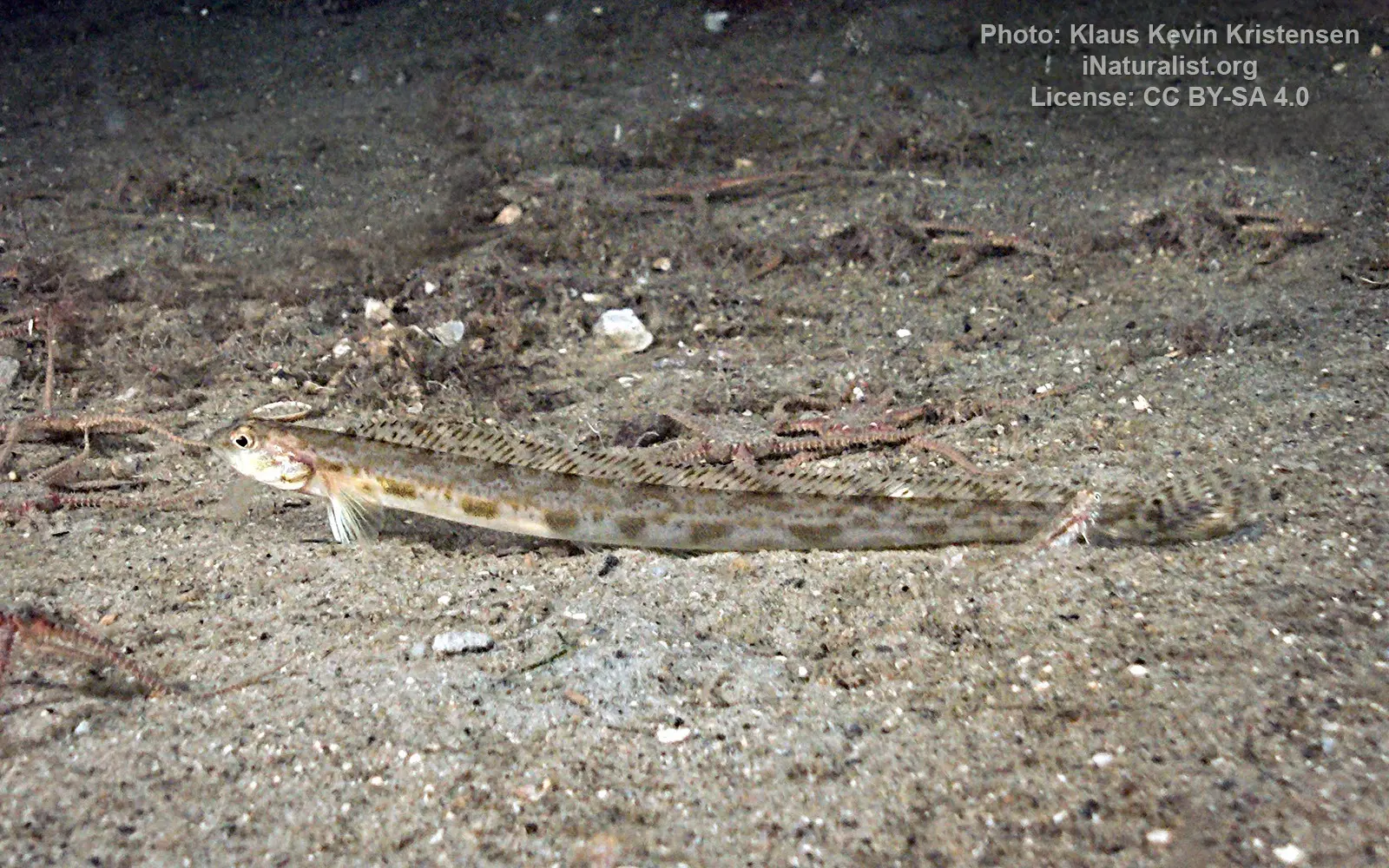
This species is a demersal fish that lives close to the seabed at depths from about 30 to 373 meters, though it is most commonly encountered between 40 and 100 meters. Snakeblennies inhabit temperate waters with temperatures roughly between 8 °C and 14 °C. They are considered non-migratory and spend most of their lives associated with soft bottoms.
The snakeblenny has a very slender, eel-like body with a pointed caudal fin. A single dorsal fin runs almost the entire length of the body, while the anal fin covers roughly two-thirds of the total length. Its coloration is typically pale brown on the back, bluish along the sides, and greenish-yellow on the underside, with many irregular brown patches scattered across the body. Individuals can grow up to about 50 cm in total length.
This benthic species lives in distinctive Y-shaped tubes burrowed into muddy seabeds, usually at depths of 50–200 meters. These burrows are thought to play a role in protecting and caring for eggs. Snakeblennies feed mainly on small bottom-dwelling invertebrates such as crustaceans, mollusks, brittle stars, and marine worms. They reach maturity at around three years of age when they are about 20 cm long.
Spawning occurs during winter, typically in December and January. Females lay around 1,000 eggs on the sea floor in deeper waters, where the burrows may provide shelter for developing eggs. A small isolated population in the Baltic Sea is believed to be a relict from the last Ice Age, originating from a time when saltwater conditions first reached the basin.