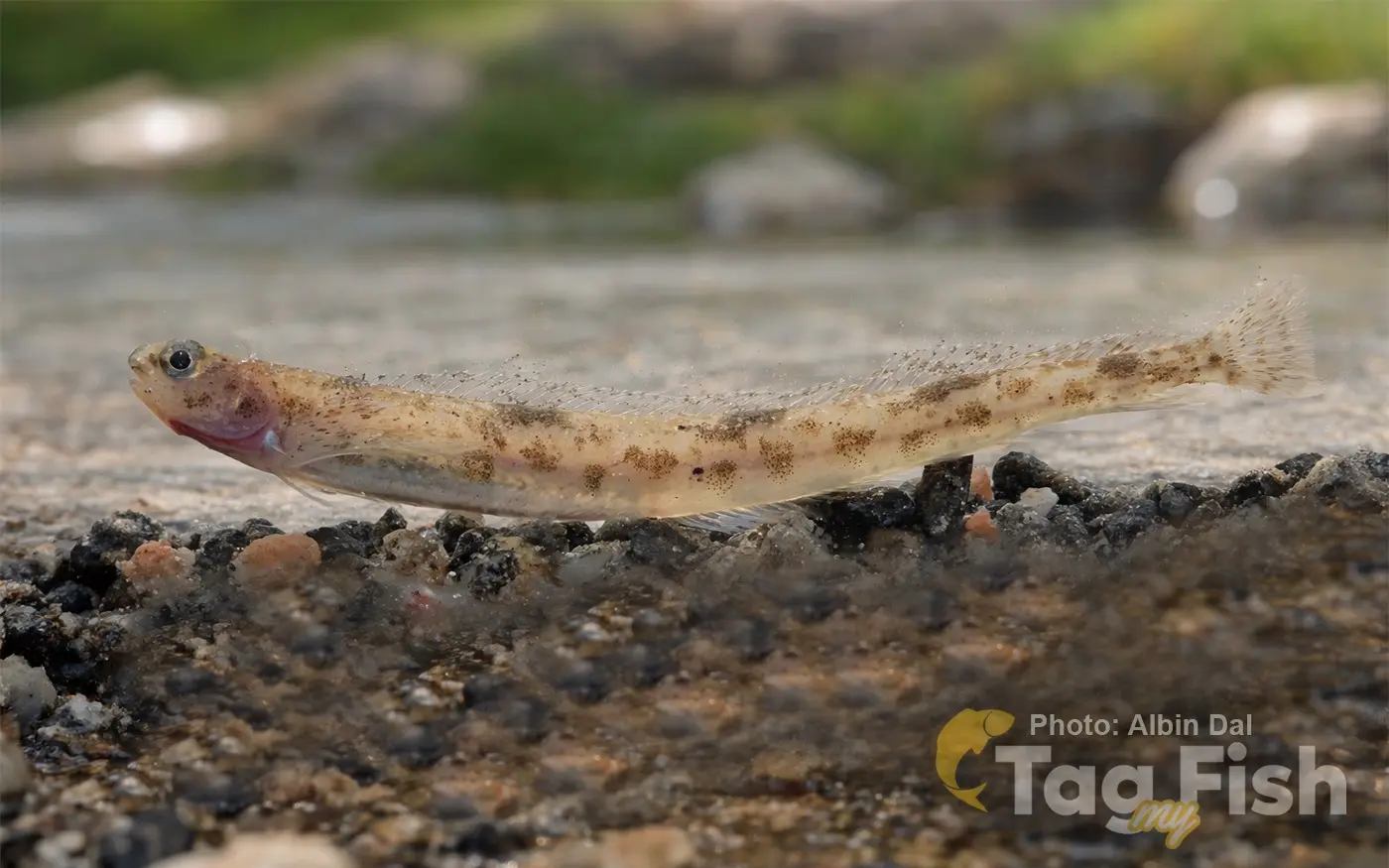


Daubed shanny (Leptoclinus maculatus)
Image source: Albin Dal
General data
- Main name: Daubed shanny
- Local names: Langbarn
- Climates: Temperate, Subpolar
- Habitat: Saltwater
- Native: Europe, Asia, North America
- Distribution: Barents Sea, Norwegian sea, Arctic ocean, Pacific Ocean, Atlantic Ocean
Classification
- Genus: Leptoclinus - Leptoclinus
- Family: Lumpenidae - Eel pricklebacks
- Order: Scorpaeniformes - Mail-cheeked fishes
- Class: Actinopteri - Ray-finned fishes
- Superclass: Osteichthyes - Bony fishes

The Leptoclinus maculatus, commonly known as the daubed shanny, is a small marine fish belonging to the family Stichaeidae. This species inhabits cold northern waters and is adapted to life close to the seabed. It is considered a demersal fish, living primarily near the bottom at depths ranging from 2 to 607 meters. The species occurs in extremely cold environments within the polar climate zone, tolerating temperatures roughly between -2°C and 2°C.
Its geographical range spans a large portion of the northern hemisphere, between approximately 79°N and 43°N, extending across longitudes from 180°W to 180°E.
Leptoclinus maculatus has a broad circumpolar distribution throughout Arctic and adjacent temperate waters. In the Pacific Ocean it occurs from Arctic Alaska through the Bering region to the Sea of Okhotsk and the northern Sea of Japan, including areas such as Unalaska Island in the Aleutian chain and reaching as far south as Puget Sound in Washington, USA. In the Atlantic Ocean the species ranges from the Arctic southward to Labrador in Canada and along the coasts of Scandinavia from the Skagerrak to Finnmark. It is particularly common in regions such as Murmansk, the White Sea, and around Iceland and Greenland.
Some researchers recognize a Pacific form as a subspecies called Leptoclinus maculatus diaphanocarus.
This species is relatively small. Individuals usually reach sexual maturity at about 12.5 cm in length, typically within a range of 13 to 13 cm, and the maximum recorded total length is approximately 20 cm. Like many Arctic fishes, its life history is adapted to cold-water ecosystems where growth rates and reproductive timing are strongly influenced by temperature and seasonal productivity. The body of
Leptoclinus maculatus is elongated and slender. Morphologically, it is characterized by a long dorsal fin with 57–60 dorsal spines and no dorsal soft rays. The anal fin contains 1–2 spines and 34–36 soft rays. The caudal fin is rounded, and one of its most distinctive features is the set of five greatly elongated lower pectoral rays that extend outward from the fin. The coloration is generally greyish to yellowish, marked with irregular dark spots scattered across the body, a pattern that likely provides camouflage against rocky or uneven seabed habitats.