

Kawakawa (Euthynnus affinis)
General data
- Main name: Kawakawa
- Local names: Mackerel tuna, Little tuna, Island skipjack, Eastern little tuna, Dwarf bonito, Bonito
- Climates: Tropical
- Habitat: Saltwater
- Native: Africa, Asia, Australia & Oceania
- Distribution: Pacific Ocean, Indian ocean
Classification
- Genus: Euthynnus - Euthynnus
- Family: Scombridae - Mackerels and tunas
- Order: Scombriformes - Mackerels
- Class: Actinopteri - Ray-finned fishes
- Superclass: Osteichthyes - Bony fishes

Description
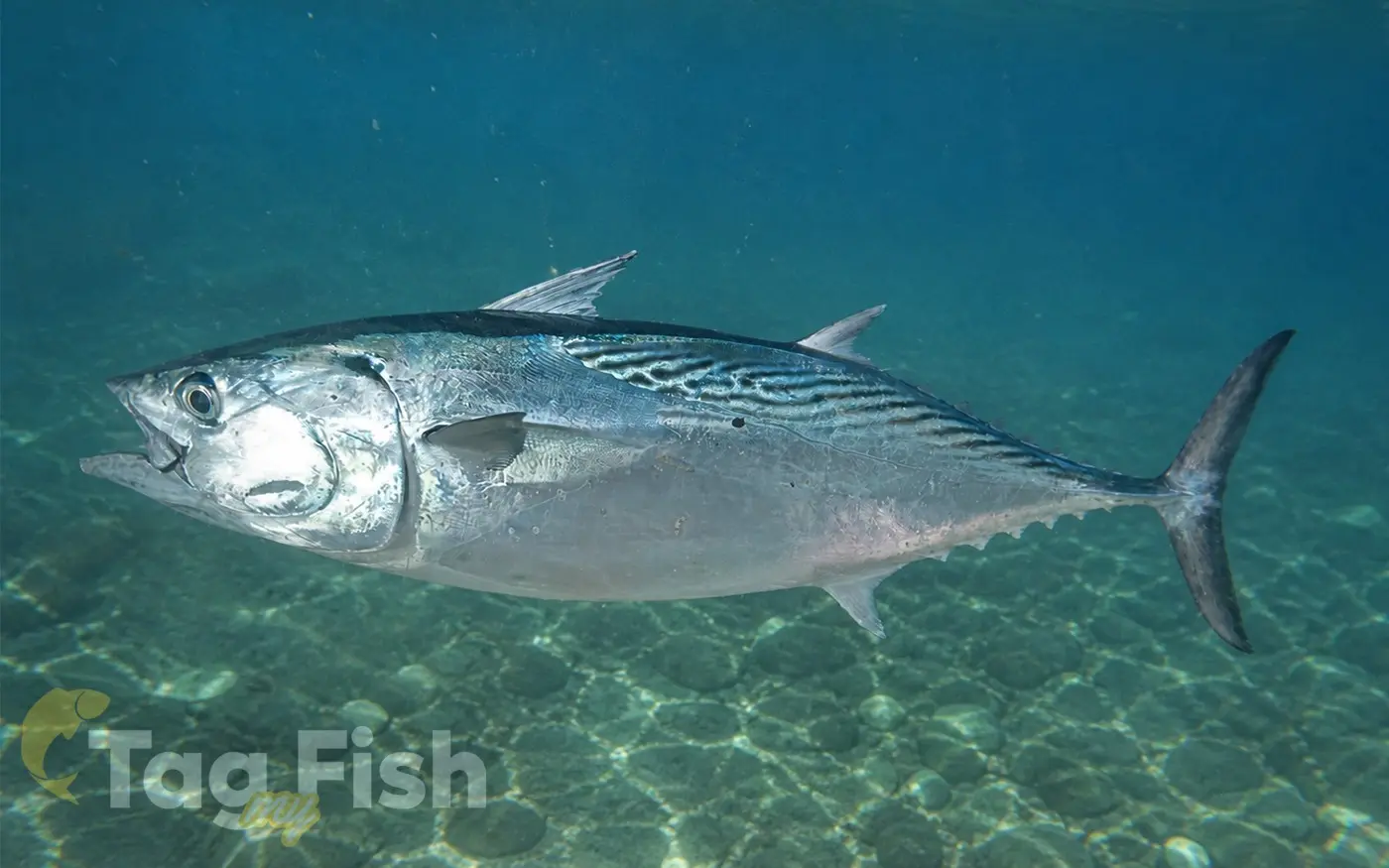
Euthynnus affinis displays a typical tuna body shape with a slender, elongated body and a deeply forked tail. It has a small amount of scales and two or more dark spots between the pelvic and pectoral fins. The first dorsal fin has 10–15 spines and is around one-third of the fish's body height. On its back, it displays 12 oblique stripes and a dark blue coloration used for countershading. This species can reach a maximum length of 1.1 metres (3.6 ft) and a weight of up to 15 kilograms (33 lb).
To distinguish it from the closely related black skipjack (also found in the Pacific Ocean), the kawakawa has more broken stripes rather than straight, continuous stripes along the body. Compared to the little tunny, primarily found in the Atlantic Ocean, the stripes on the back of Euthynnus affinis are more orderly.
Distribution and Ecology
Euthynnus affinis is an Indo-Pacific species distributed from the Red Sea to French Polynesia, and it can also be found near Baja California.
The kawakawa is a pelagic and highly migratory species, typically schooling from the surface down to depths of about 200 metres (660 ft). However, it often remains close to coastal areas and neritic shelves rather than the open ocean. It is also known to inhabit coastal reefs and occasionally enter estuaries. This species prefers water temperatures between 18–29 °C (64–84 °F).
It is an opportunistic feeder, preying on squid, fish, crustaceans, and zooplankton. Like other tuna species, it frequently forms large mixed-species schools with other Scombridae, such as yellowfin tuna and frigate mackerel.
Predators of Euthynnus affinis include larger tuna, billfish, sharks, seabirds, and marine mammals.