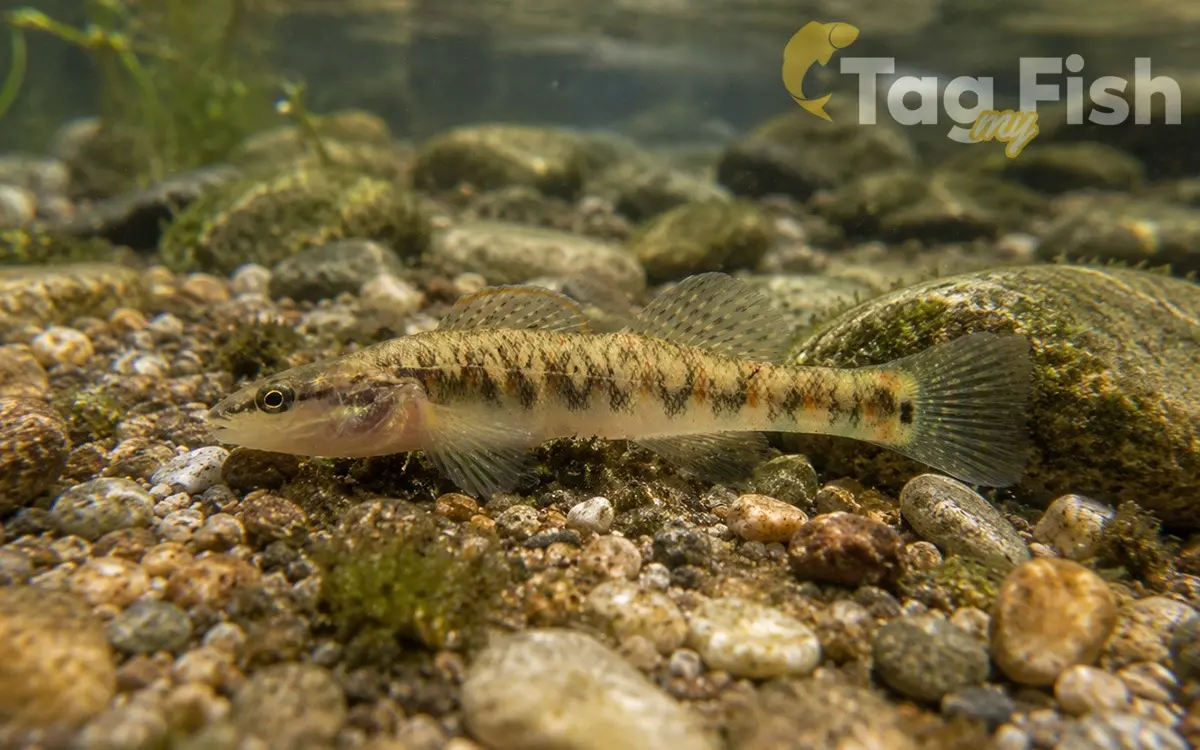
Arrow darter (Etheostoma sagitta)
Image source: Generated by ChatGPT
General data
- Main name: Arrow darter
- Climates: Temperate
- Habitat: Freshwater
- Native: North America
- Distribution: Ohio River
Classification
- Genus: Etheostoma - Darters
- Family: Percidae - Perches
- Order: Perciformes - Perches
- Class: Actinopteri - Ray-finned fishes
- Superclass: Osteichthyes - Bony fishes

The arrow darter is found in parts of Kentucky and Tennessee, particularly in the Cumberland and Kentucky Rivers
They grow to be about 4.5 inches (11 cm) in length.
Their opercle, breast, and cheek are all unscaled. They have a vertical black bar at the base of their caudal fin. Six to nine vertical banded bars run down the side of the fish. The dorsal side of the fish is olive green in color, and the ventral side is a yellow to white pattern.
The first dorsal fin has a black base, followed by green color, and then a reddish-orange end. The second dorsal is clear with two rows of laterally lined orange spots. The caudal fin is clear and has two-three vertical lines of orange spots. The anal fin has a green base and then clear at the end.
The breeding male has bright orange-red spots and breeding tubercles present on the scales.
Diet Arrow darters usually feed on insect larvae, such as blackflies, caddisfly, and beetles. They also frequently feed on mayflies and midges.
If the darter is greater than 2.8 inches (7.1 cm), they often feed on small crayfish.
Arrow darters are often found in shallow pools of water near large, flat stones. The streams they are found in are so small they are sometimes reduced to puddles. They can be found around wooded debris and rock ledges.
This species was found in at least 74 streams in the upper Kentucky River basin. However, surveys have tested and populations of the arrow darter can be found in 47 streams across the same region.