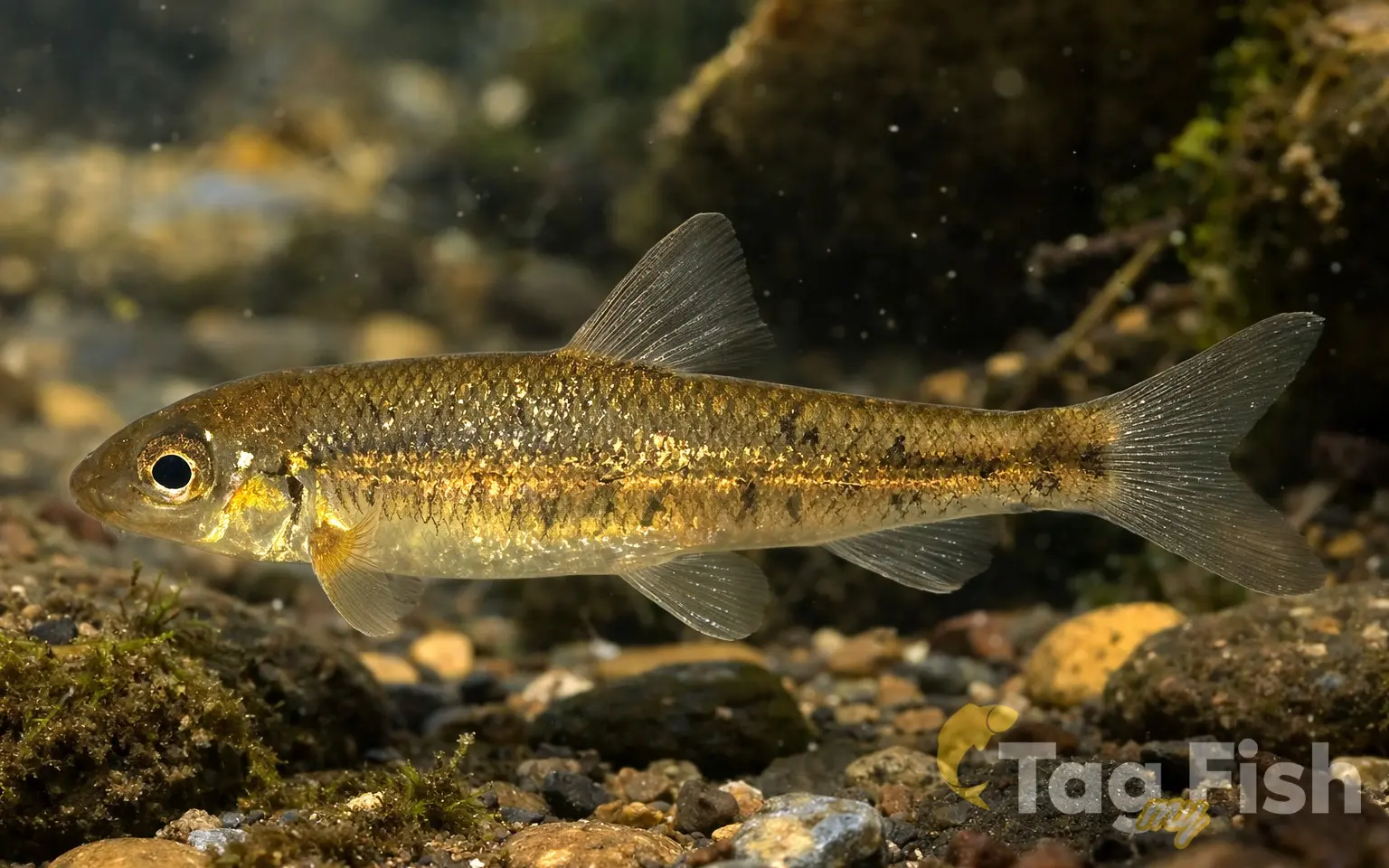


Gravel chub (Erimystax x-punctatus)
Image source: Created by ChatGPT
General data
- Main name: Gravel chub
- Climates: Continental
- Habitat: Freshwater
- Distribution: Mississippi River, St. Lawrence River, Atchafalaya River
Classification
- Genus: Erimystax - Slender chubs
- Family: Leuciscidae - Chub family
- Order: Cypriniformes - Carps
- Class: Actinopteri - Ray-finned fishes
- Superclass: Osteichthyes - Bony fishes

Erimystax x-punctatus, commonly known as the gravel chub or spotted chub, is a species of freshwater ray-finned fish belonging to the family Leuciscidae, a large group that includes shiners, daces, and minnows. This small North American fish has a patchy distribution and inhabits various clean rivers and streams. The gravel chub requires a very specific habitat with clear water and clean gravel substrates, making it particularly sensitive to pollution and environmental changes, and therefore a species of conservation concern in parts of its range.
Description
The gravel chub is a medium-sized minnow that usually grows to less than 10 cm in length. It has a slender body that is generally silvery with an olive tint on the back and a lighter, almost white underside. The scales display a distinctive crosshatch pattern, giving the fish a slightly textured appearance.
This species is often confused with the streamline chub, but it can be distinguished by its more pronounced crosshatched scales and the absence of dark blotches along the lateral line. The lateral line runs straight along the body from the head to the tail and contains around 40–43 cycloid scales.
The gravel chub has a subterminal mouth with small barbels extending from the upper and lower maxillary jaw bones, which help the fish detect food along the riverbed. Its fins are supported by soft rays and it does not possess an adipose fin. The pectoral fins, consisting of approximately 13–16 rays, are pointed and positioned relatively low on the body. The pelvic fins are rounded with about eight rays and are located slightly behind the dorsal fin in the abdominal position. The fish has a moderately forked homocercal tail that assists in swimming in flowing water.
Distribution and Habitat
The gravel chub is primarily found in the northeastern regions of North America, though its distribution is somewhat scattered. Historical records show populations in Ontario’s Thames River, although the species has not been documented there since 1958. Later surveys in the 1970s and 1980s confirmed its absence from that river system.
Across the United States, the species occurs from south-central Arkansas northward to southern Minnesota and eastward to western New York. In many states the fish is restricted to only a few waterways. For example, in New York the gravel chub is found only in the drainage of the Allegheny River, while in Minnesota it occurs mainly in two Mississippi River tributaries: the Root River and the Upper Iowa River. In Wisconsin, populations are limited to the lower Rock River system, including the lower Pecatonica River, the lower Sugar River, and the main channel of the Rock River.
Gravel chubs inhabit small rivers and medium to large creeks and streams, particularly areas with moderate current known as riffles. During the summer they are commonly found in waters with temperatures between 18 °C and 25 °C. They prefer relatively flat sections of riverbeds and are often located near the tail ends of rapids or the heads of pools, where riffles are most common.
The species favors substrates composed of fine limestone gravel and pea-sized stones. Gravel chubs require clear, well-oxygenated water and are highly intolerant of excessive silt, sediment, and debris. They are usually found in areas with limited aquatic vegetation, although algae, moss, and small rooted plants may be present.
Because of their strict habitat requirements, gravel chubs are especially vulnerable to water pollution and habitat degradation, particularly from agricultural runoff that causes erosion and increases sediment levels. In some rivers where the species was once recorded, such as the Upper Iowa River near Le Roy, Minnesota, populations have disappeared due to sewage pollution, pesticides, and sedimentation. For this reason, the presence of gravel chubs in a river system is often considered an indicator of high water quality and a healthy aquatic ecosystem.