
Barred soapfish (Diploprion bifasciatum)
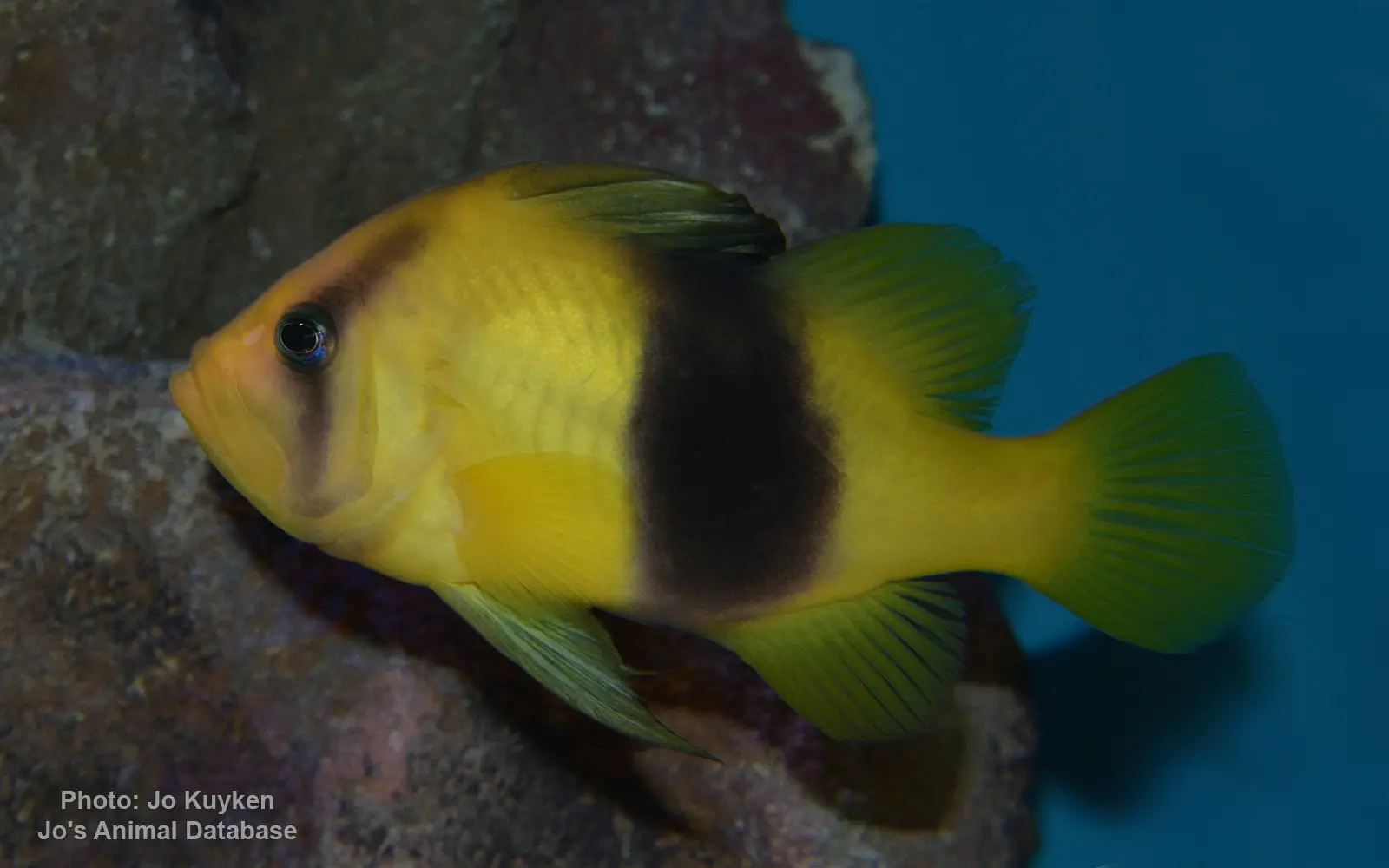
Image source: Jo's Animal Database
General data
- Main name: Barred soapfish
- Local names: Yellow striped grouper, Yellow emperor, Two-banded sea-perch, Two-banded perch
- Habitat: Saltwater
- Native: Asia, Australia & Oceania
- Distribution: Pacific Ocean, Indian ocean
Classification
- Genus: Diploprion - Diploprion
- Family: Liopropomatidae - Painted basslets
- Order: Perciformes - Perches
- Class: Actinopteri - Ray-finned fishes
- Superclass: Osteichthyes - Bony fishes

Description
Diploprion bifasciatum, the barred soapfish, also known as the double-banded soapfish, two banded grouper, two-banded sea perch, two-banded soapfish, yellow emperor or yellow striped grouper, is a species with a compressed, moderately deep body that 3–3.4 times longer than its depth.
Its body is almost all covered with small ctenoid scales. The dorsal fin has a deep incision between its spined and soft rayed parts. It has long pelvic fins which extend past the spiny portion of the anal fin. The dorsal fin has 8 spines and 13–16 soft rays while the anal fin contains 3 spines and 12–13 soft rays.
The colour of this species normally ranges from pale yellow or greyish-yellow to bright yellow with a dark bar which runs through the eye and another wider dark band on the posterior part of its body with yellow fins. The larger fishes can be nearly all black with yellow fins. The small juveniles are bluish in colour on the anterior part of their bodies and yellow on the posterior part, they also have a spiny part of the dorsal fin coloured black. The juveniles appear to mimic whichever local species of venomous blennies in the genus Meiacanthus which are blue or grey in colour.
This species attains a maximum total length of 25 centimetres (9.8 in).
Diploprion bifasciatum has a wide distribution in the Indo-West Pacific. Its range extends from the Maldives and India east to Papua New Guinea, the Solomon Islands and New Caledonia, north as far as southern Japan south to Australia.
In Australia its distribution extends from Rottnest Island in Western Australia to the Solitary Islands Marine Park in New South Wales, although juveniles may be found further south. They are also found around Lord Howe Island in the Tasman Sea.