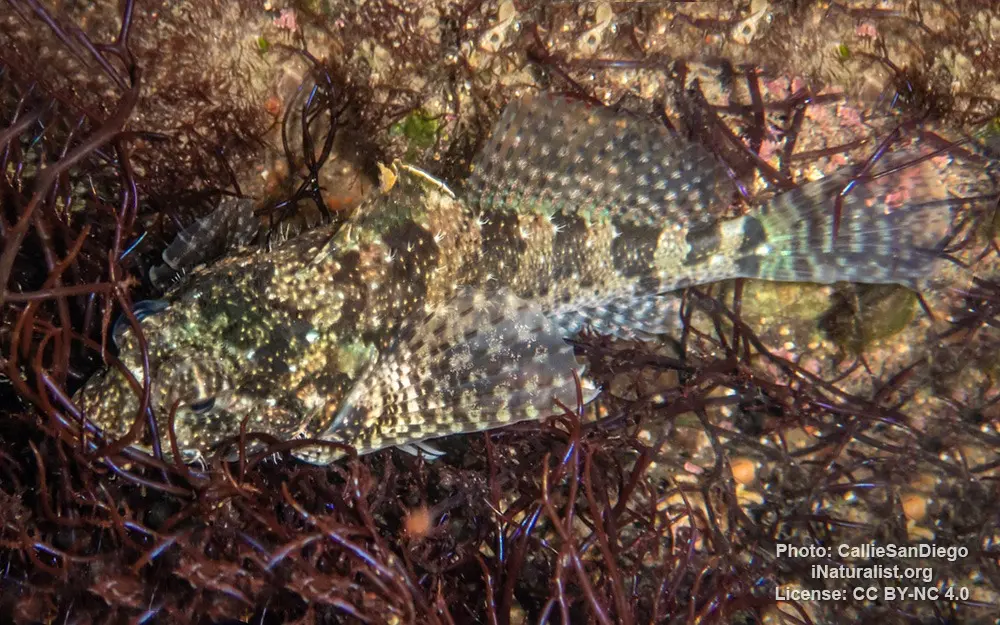


Woolly sculpin (Clinocottus analis)
Image source: CallieSanDiego | inaturalist.org
General data
- Main name: Woolly sculpin
- Climates: Subtropical
- Habitat: Saltwater
- Native: North America
- Distribution: Pacific Ocean
Classification
- Genus: Clinocottus - Clinocottus
- Family: Cottidae - Cottids
- Order: Scorpaeniformes - Mail-cheeked fishes
- Class: Actinopteri - Ray-finned fishes
- Superclass: Osteichthyes - Bony fishes

Woolly sculpin (Clinocottus analis) is a small species of ray-finned marine fish belonging to the family Cottidae, commonly known as the typical sculpins. It inhabits the eastern Pacific Ocean and is commonly found along the rocky coastlines of California and Baja California. This fish is especially well known to tide-pool visitors because it often lives in shallow coastal pools that are exposed during low tide.
The woolly sculpin grows to about 18 cm in length. It has an elongated, mottled body and a large, wide, flattened head, giving it a somewhat frog-like appearance. Its eyes sit high on the head and face upward, while the wide mouth contains many small teeth suited for catching small prey. Unlike many fishes, this species is scaleless; instead its skin is thick and textured. The body is supported by dorsal, anal, and caudal fins with 12–15 rays, and the rounded tail fin is usually darker than the rest of the body.
Clinocottus analis is a demersal species that lives on the seabed in intertidal zones down to about 18 meters. It is frequently found hiding among rocks and seaweeds in tide pools, where it feeds on small crustaceans, worms, and other invertebrates. One of its most interesting abilities is its tolerance for harsh tidal conditions: the woolly sculpin can breathe air and survive out of water for up to 24 hours, allowing it to endure periods when tide pools temporarily dry out or become poorly oxygenated.
This hardy little fish is an important part of the coastal tide-pool ecosystem, acting as both a predator of small invertebrates and prey for larger fish and seabirds. Its remarkable ability to tolerate fluctuating oxygen levels and even short periods on land makes the woolly sculpin one of the most adaptable fishes living in the challenging intertidal environment.