
Bluespotted trevally (Caranx bucculentus)
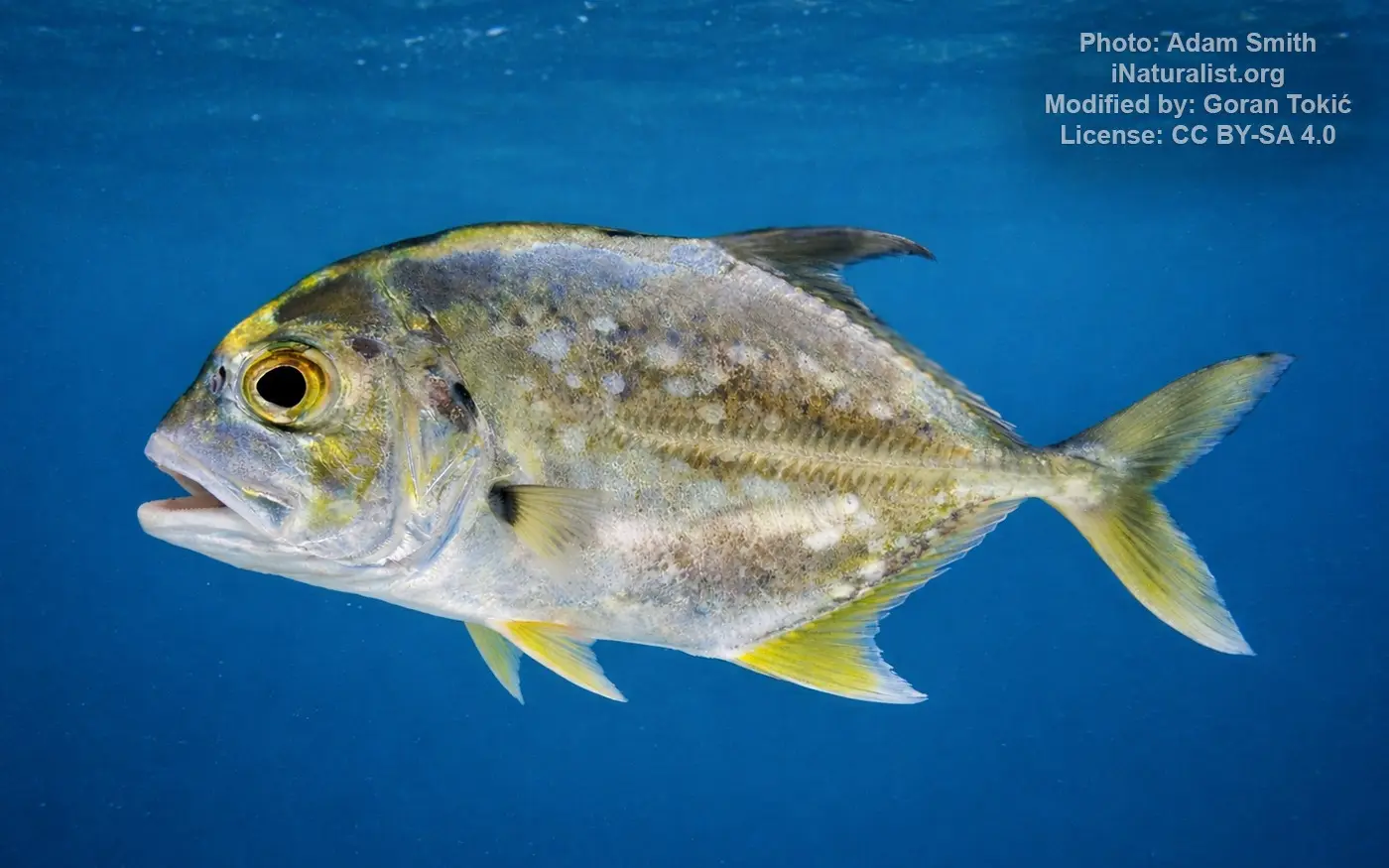
Image source: Adam Smith | inaturalist.org
General data
- Main name: Bluespotted trevally
- Local names: Blue-spotted trevally, Wide-mouthed trevally
- Climates: Tropical, Subtropical
- Habitat: Saltwater
- Native: Asia, Australia & Oceania
- Distribution: Indian ocean, Pacific Ocean
Classification
- Genus: Caranx - Trevally
- Family: Carangidae - Jacks
- Order: Carangiformes - Jacks
- Class: Actinopteri - Ray-finned fishes
- Superclass: Osteichthyes - Bony fishes

Description
The bluespotted trevally (Caranx bucculentus) is a moderately large member of the jack family, notable for its robust build and distinctive markings. Its body is strongly compressed and oblong, with a more rounded back than belly, giving it a powerful, predatory appearance.
Adults are pale olive to silvery white, marked with numerous small dark blue spots across the upper body, a dark blotch on the gill cover, and another near the base of the pectoral fin.
The fins are typically yellow-green, adding to its characteristic look. In terms of size, the bluespotted trevally grows relatively quickly, reaching sexual maturity at a small size and young age compared to other trevallies.
It can grow at an average rate of over 80 mm per year and reaches a maximum known length of about 66 cm, making it a medium-to-large coastal predator rather than a true giant trevally.
The species is distributed across the tropical eastern Indian Ocean and western Pacific, from Taiwan and the South China Sea southward through Indonesia and Papua New Guinea to northern Australia. It is especially abundant in the Gulf of Carpentaria.
Bluespotted trevally are primarily inshore fish, favoring sandy and muddy bottoms in bays and coastal waters, sometimes near seagrass beds, where they play an important ecological role as one of the dominant predators in these shallow marine environments.