Yellowspotted trevally (Carangoides fulvoguttatus)
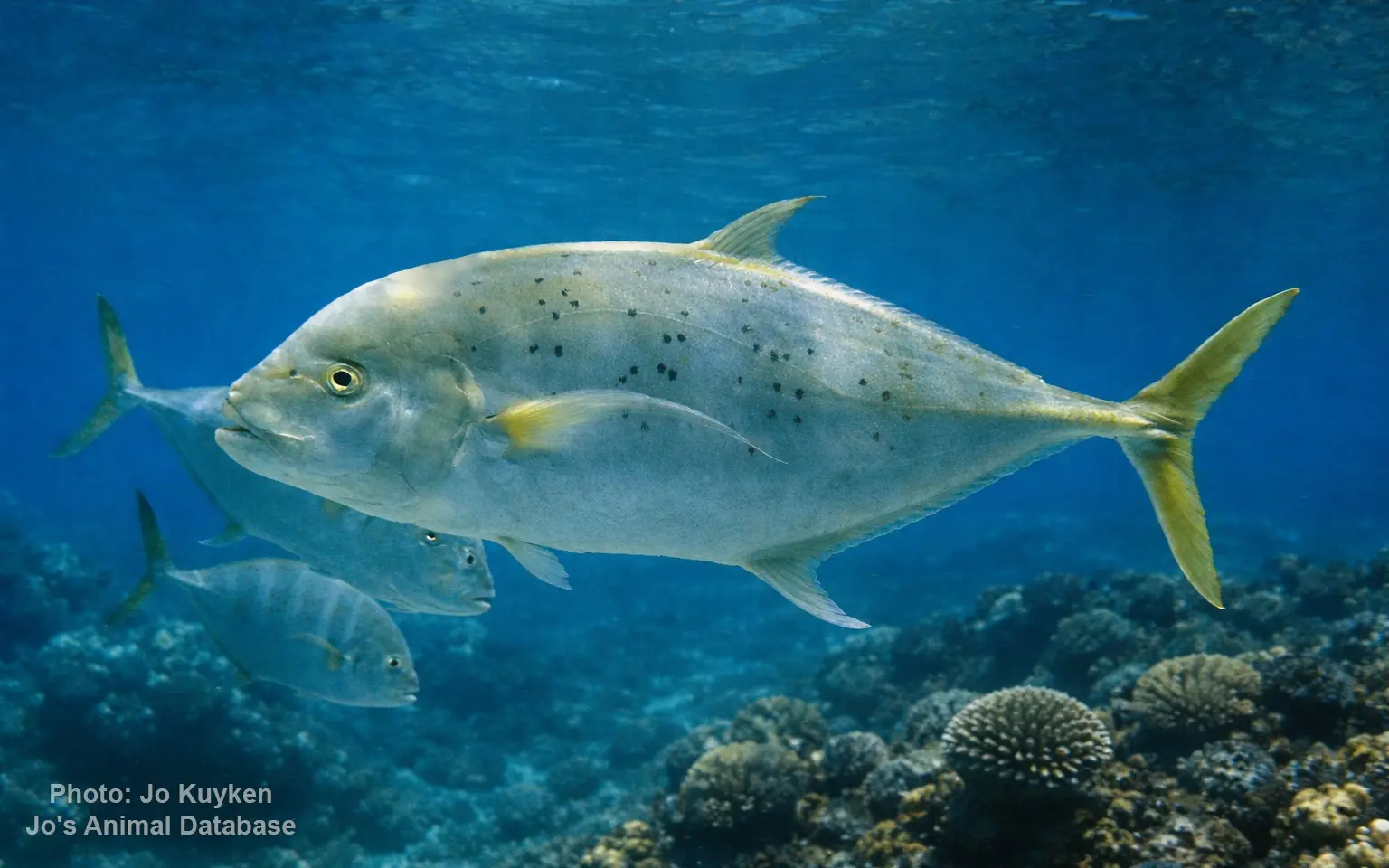
Image source: Jo's Animal Database
General data
- Main name: Yellowspotted trevally
- Local names: Yellowspotted kingfish, Goldspotted trevally, Turrum
- Climates: Tropical, Subtropical
- Habitat: Saltwater
- Native: Africa, Asia, Australia & Oceania
- Distribution: Red sea, Indian ocean, Pacific Ocean
Classification
- Genus: Carangoides - Carangoides
- Family: Carangidae - Jacks
- Order: Carangiformes - Jacks
- Class: Actinopteri - Ray-finned fishes
- Superclass: Osteichthyes - Bony fishes

Yellowspotted Trevally (Carangoides fulvoguttatus) is a large, fast-swimming marine fish belonging to the jack family Carangidae. It is known for its elongated, streamlined body and strong predatory behavior.
Description: The species can grow up to 1.2 m in length and reach weights of around 18 kg. It has a more cylindrical and elongated body compared to many other trevallies, becoming more streamlined with age. Juveniles are mostly silvery, while adults develop a bluish-green upper body.
The most distinctive feature of this species is the presence of numerous small golden or yellow spots scattered across the upper sides. Larger individuals may also show faint dark blotches along the flanks. The fins are typically yellowish to dusky, and the deeply forked tail reflects its strong swimming ability.
Distribution and habitat: The yellowspotted trevally is widely distributed throughout the tropical and subtropical Indo-Pacific. Its range extends from South Africa and the Red Sea across India and Southeast Asia, through Indonesia, and eastward to Japan, Australia, Palau, Tonga, and New Caledonia.
It mainly inhabits inshore coastal waters, especially around rocky and coral reefs, lagoons, and island environments. It can also occur over deeper offshore sandy areas down to about 100 m, but generally avoids low-salinity waters and is rarely found in estuaries.