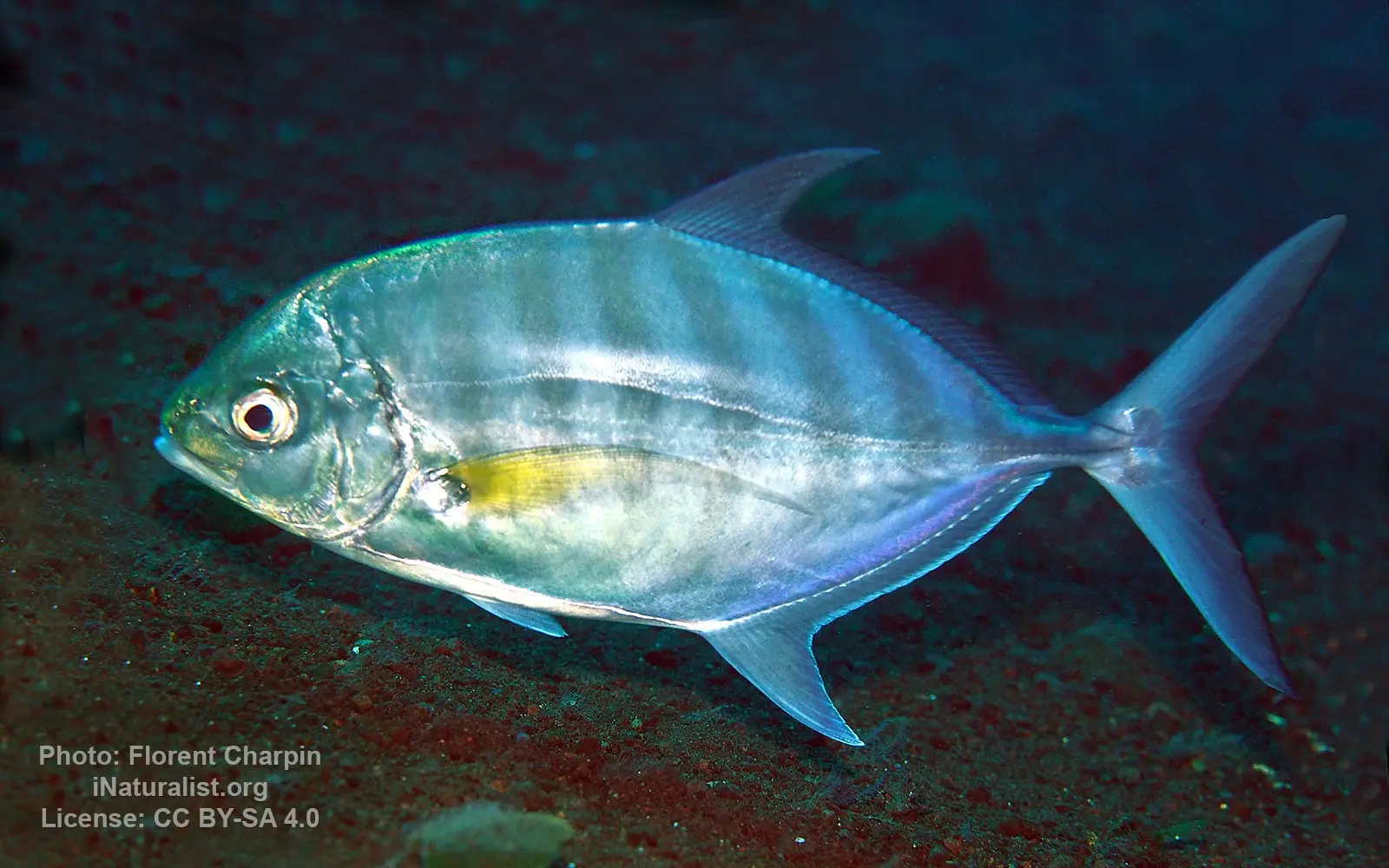
Blue trevally (Carangoides ferdau)
Image source: Florent Charpin | inaturalist.org
General data
- Main name: Blue trevally
- Climates: Tropical
- Habitat: Saltwater
- Native: Africa, Asia, Australia & Oceania
- Distribution: Indian ocean, Pacific Ocean
Classification
- Genus: Carangoides - Carangoides
- Family: Carangidae - Jacks
- Order: Carangiformes - Jacks
- Class: Actinopteri - Ray-finned fishes
- Superclass: Osteichthyes - Bony fishes

Blue trevally (Ferdauia ferdau), also known as the banded trevally or barred trevally, is a widespread pelagic marine fish belonging to the jack family Carangidae. It is a moderately large and active predator commonly found in tropical and subtropical coastal waters.
Description: The blue trevally grows up to about 70 cm in length and can reach weights of around 8 kg. It has a compressed, oblong body with a slightly more convex dorsal profile and a blunt, rounded snout. The species is easily recognized by its blue-green to yellow-green coloration on the back, fading to silvery on the underside. Adults typically display five to six dark vertical bands along the body, along with small golden spots on the upper sides. The fins are generally yellowish-green, with the tail fin showing darker edges. Like other jacks, it has two dorsal fins and a strongly forked tail, adapted for fast swimming.
Distribution: The blue trevally is widely distributed throughout the tropical and subtropical Indo-Pacific region. Its range extends from South Africa and the Red Sea along the East African coast, across the Indian Ocean to India and Southeast Asia, and further east to Australia, Japan, Hawaii, and many Pacific islands such as Micronesia, New Caledonia, and Tonga. It inhabits coastal waters down to about 60 meters in depth, commonly found around reefs, lagoons, sandy bottoms, and beaches. As a pelagic species, it can move between islands and atolls, but it is rarely found in estuaries due to low salinity tolerance.