
Sunrise perch (Caprodon schlegelii)
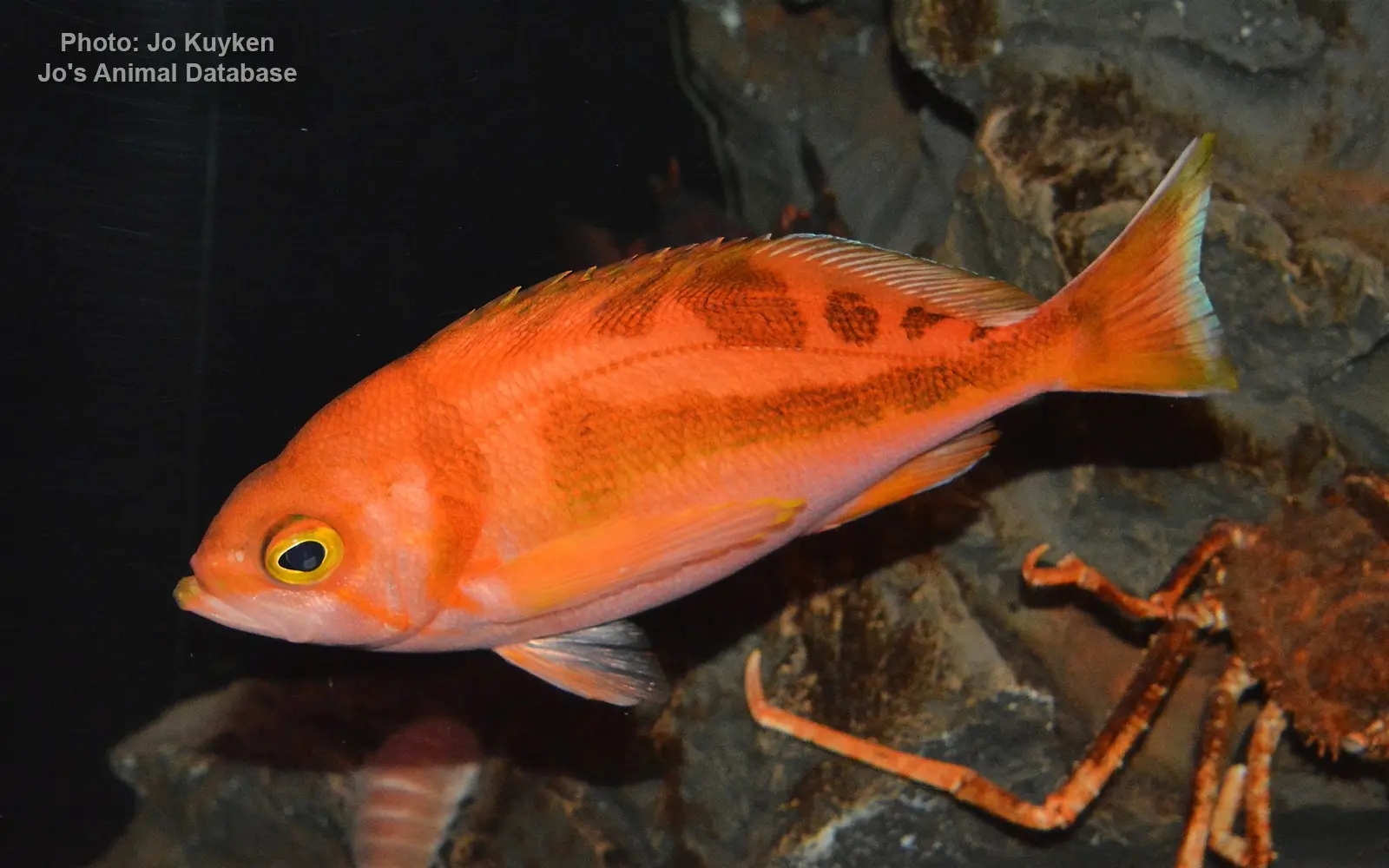
Image source: Jo's Animal Database
General data
- Main name: Sunrise perch
- Climates: Tropical, Subtropical
- Habitat: Saltwater
- Native: Asia, Australia & Oceania
- Distribution: Pacific Ocean, Indian ocean
Classification
- Genus: Caprodon - Caprodon
- Family: Anthiadidae - Anthiadidae
- Order: Perciformes - Perches
- Class: Actinopteri - Ray-finned fishes
- Superclass: Osteichthyes - Bony fishes

Description
Caprodon schlegelii, commonly known as the sunrise perch, is a subtropical marine fish found in the Southeastern Indian Ocean and the western Pacific, displaying an antitropical distribution pattern.
It inhabits benthopelagic zones and is typically encountered at depths ranging from 50 to 200 meters.
These habitats include offshore reefs and deeper continental shelf areas where it moves close to the bottom but also ascends into the water column to feed.
This species is notable for its striking coloration. Adults are predominantly orange-red, accented by a series of black spots at the base of the dorsal fin.
The body is fusiform and laterally compressed, giving it a streamlined shape suited for active swimming in open water.
The dorsal fin is characterized by 10 spines and 19–21 soft rays, while the anal fin bears 3 spines and 7–8 soft rays.
Both males and females exhibit congruent dorsal rays, though their tail fin shapes differ subtly. Males have a rounded caudal fin lacking a pronounced median notch, with only slight indentations above and below, whereas females show a very shallow central notch.
Sunrise perch grow to a maximum recorded length of 35 cm total length in males and unsexed individuals, while females reach up to 25 cm.
Precise maturity size is not yet known. Although much of the species’ life history remains to be studied, its morphology and distribution suggest it plays a typical role among deeper-water perches, feeding on small fishes and invertebrates while occupying mid- to lower-water layers above complex substrates. Caprodon schlegelii is an eye-catching representative of subtropical benthopelagic ecosystems, valued by divers and ichthyologists alike for its color pattern and distinctive fin structure.