Blue and gold fusilier (Caesio caerulaurea)
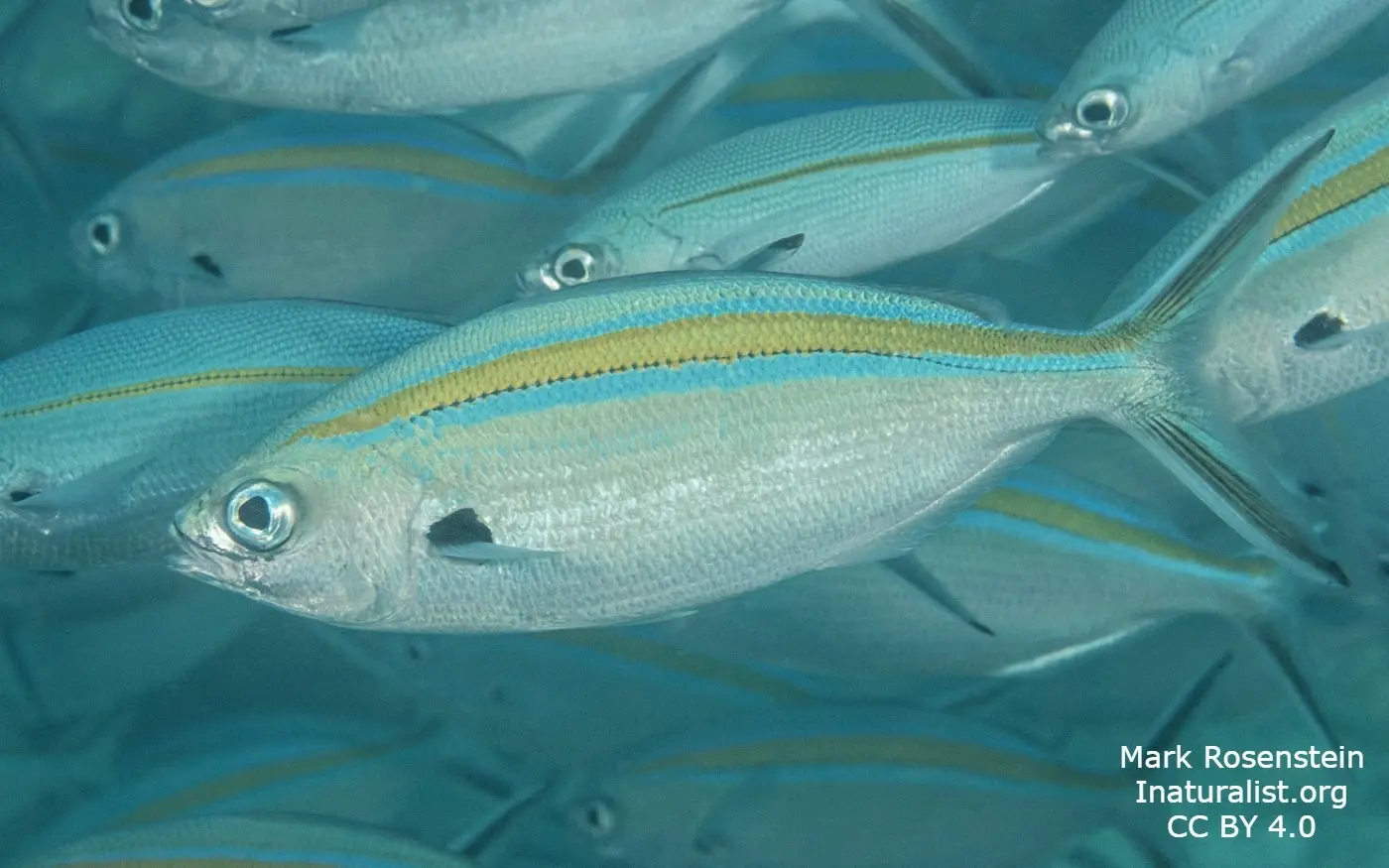
Image source: Mark Rosenstein
General data
- Main name: Blue and gold fusilier
- Local names: Scissor-tailed fusilier, Scissor tailed fusilier, Gold-banded fusilier, Gold-band fusilier, Blue-and-gold fusilier, Blue fusiler
- Climates: Tropical, Subtropical
- Habitat: Saltwater
- Native: Africa, Asia, Australia & Oceania
- Distribution: Indian ocean, South China Sea, Pacific Ocean, Red sea
Classification
- Genus: Caesio - Caesio
- Family: Caesionidae - Fusiliers
- Order: Perciformes - Perches
- Class: Actinopteri - Ray-finned fishes
- Superclass: Osteichthyes - Bony fishes

Caesio caeruaurea has a quite deep, fusiform, elongated body which shows moderate lateral compression. There are small conical teeth in the jaws as well as on the vomer and the palatine.
The dorsal fin has 10 spines and 14–16 soft rays while the anal fin contains 3 spines and 10–12 soft rays. The dorsal and anal fins have scales.
This species attains a maximum total length of 35 cm (14 in), although 25 cm (9.8 in) is more typical.
The overall colour of this fusilier is bluish fusilier changing to white on the underside. There is a yellow or golden stripe over the lateral line bordered on both sides by a thin white to pale blue stripe which continues as blackish streaks on both lobes of the forked caudal fin, creating the appearance of scissors.
Caesio caerulaurea has a wide distribution in the tropical waters of the Indo-Pacific. It is found along the eastern coast of Africa from the Red Sea as far south as South Africa then east along through the Indian Ocean, although it is absent from the Persian Gulf into the Pacific. In the Pacific Ocean their range extends east as far as French Polynesia, northwards to southern Japan and south as far as Vanuatu and New Caledonia.
In Australia it is found from Shark Bay in Western Australia north to Cassini Island, the Ashmore Reef in the Timor Sea and from the northern Great Barrier Reef off, Queensland south to Sydney. It also occurs at Christmas Island and Lord Howe Island.
It occurs at depths between 2 and 40 m (6 ft 7 in and 131 ft 3 in).
This species occurs on coastal, lagoon and seaward reefs, typically where there is a healthy growth of corals.