
Bluespotted triggerfish (Balistes punctatus)
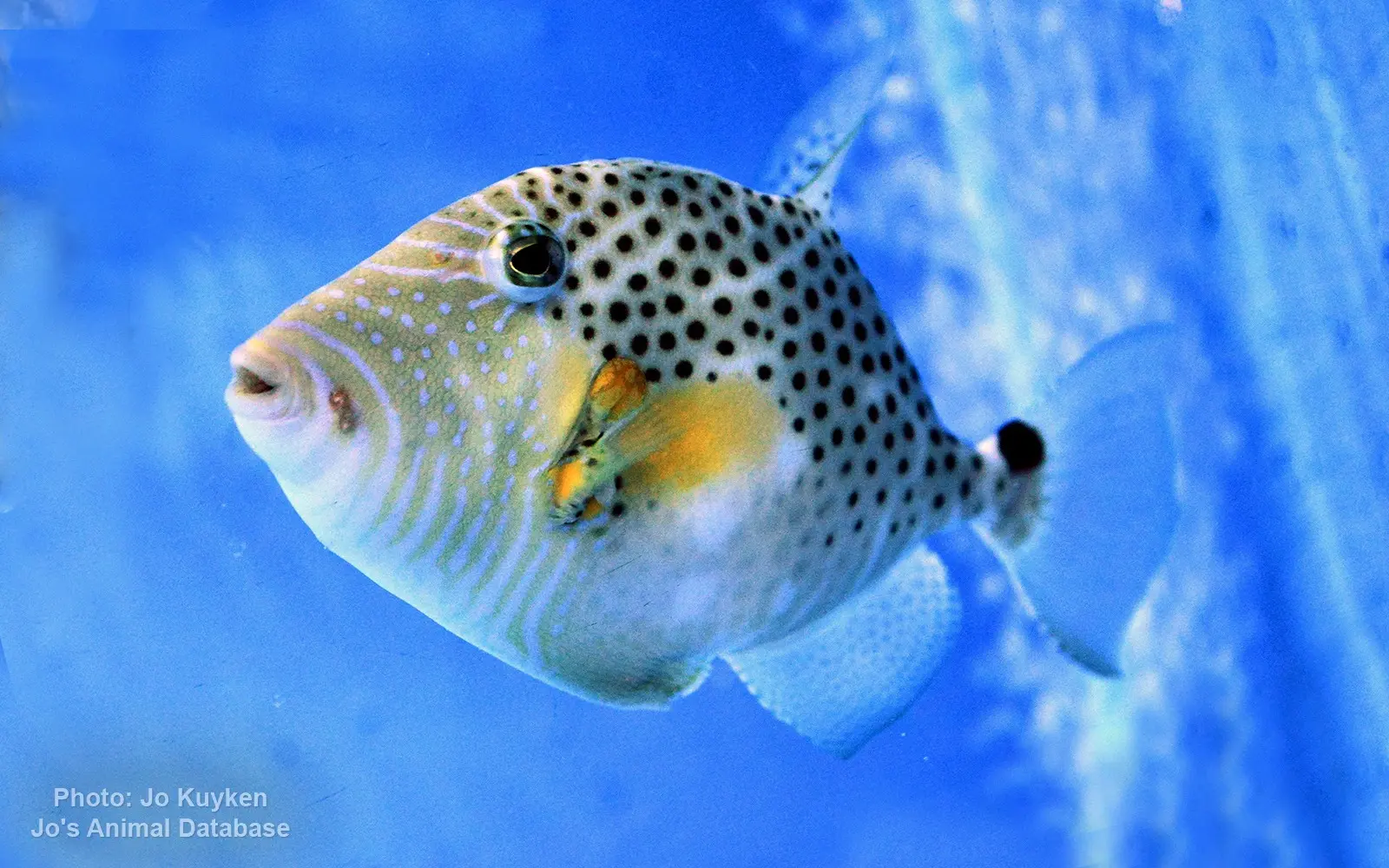
Image source: Jo's Animal Database
General data
- Main name: Bluespotted triggerfish
- Local names: Spotted triggerfish
- Climates: Tropical
- Habitat: Saltwater
- Native: Africa
- Distribution: Gulf of Guinea, Atlantic Ocean
Classification
- Genus: Balistes - Balistes
- Family: Balistidae - Triggerfishes
- Order: Tetraodontiformes - Puffers and filefishes
- Class: Actinopteri - Ray-finned fishes
- Superclass: Osteichthyes - Bony fishes
Description
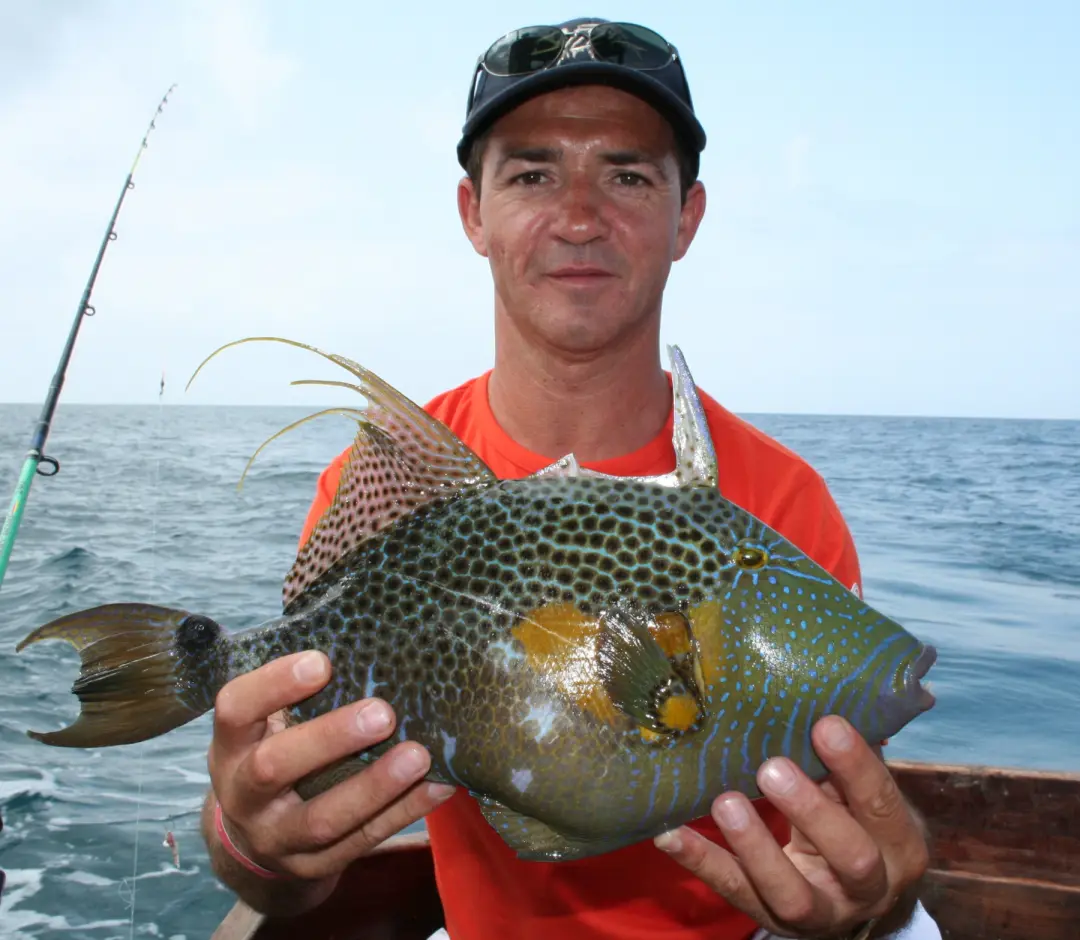
Bluespotted triggerfish has a deep and laterally compressed body. There are 3 spines on the first dorsal fin and there are between 1 and 3 spines and 26 to 28 soft rays in the second dorsal fin, with the third to sixth rays o=in the second dorsal fin are filamentous and grow beyond the fin membrane. The anal fin contains around 22–24 rays.
The caudal peduncle is laterally compressed, and the upper and lower rays in the caudal fin are elongated.
The overall colour is grey to brown with a pattern of dark spots covering almost all of the body and to the rear of the eyes, the spots fade towards the belly which is unspotted. There are 5 or 6 pale radial bluish stripes which are visible to the front of the lower orbit and there are curved pale blue lines that extend backwards and downwards across the snout, behind the mouth.
There are vertical undulating lines abve the base of the anal fin. Both the caudal fin and the dorsal fin have black spots, as does the base of the pectoral fin.
The area immediately behind the head is bright yellow.
The upper base of the caudal fin has a black blotch.
The bluespotted triggerfish has a maximum published total length of 60 cm (24 in), although typically this is 25 cm (9.8 in), and a maximum weight of 1.8 kg (4.0 lb).
Balistes punctatus is found in the Eastern Atlantic Ocean along the coast of Western Africa, between Morocco and Angola. It is also found in Madeira, Canary Islands, Cape Verde Islands and the islands in the Gulf of Guinea.
It is found at depths down to 200 m (660 ft) in coastal waters on sandy and rocky bottoms.[2]