Red Sea soldierbream (Argyrops megalommatus)
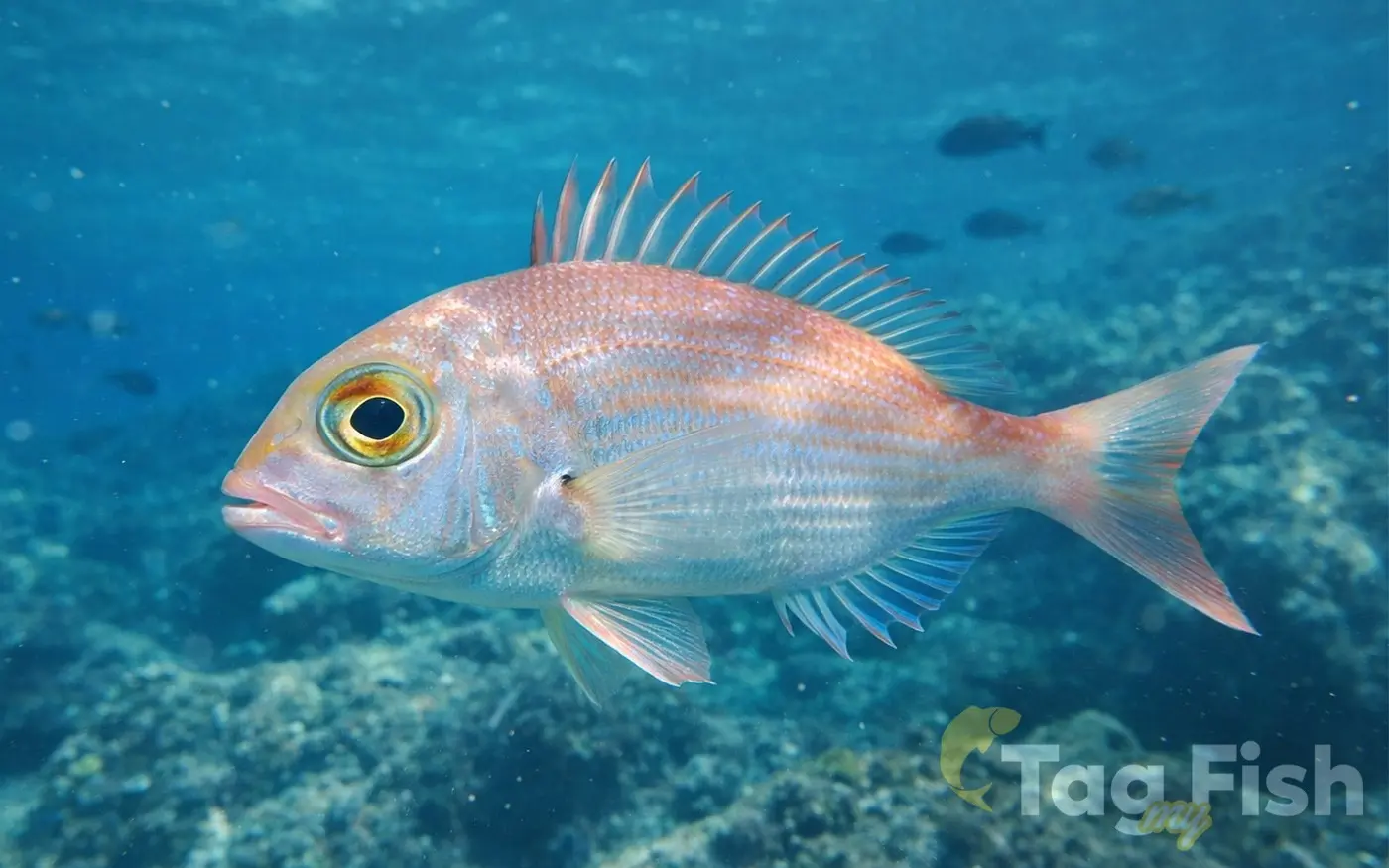
Image source: Pascal Rommelaere, modified by chatGPT
General data
- Main name: Red Sea soldierbream
- Climates: Tropical
- Habitat: Saltwater
- Native: Africa, Asia
- Distribution: Red sea, Indian ocean, Gulf of Aden
Classification
- Genus: Argyrops - Argyrops
- Family: Sparidae - Sea breams
- Order: Spariformes - Breams and porgies
- Class: Actinopteri - Ray-finned fishes
- Superclass: Osteichthyes - Bony fishes

Argyrops megalommatus is a marine ray-finned fish belonging to the family Sparidae, commonly known as seabreams or porgies. This species inhabits deeper offshore waters of the western Indian Ocean and is considered a relatively uncommon deepwater sparid. Like other members of its genus, it has a laterally compressed body and a characteristic seabream profile, but it can be recognized by a combination of morphological features and coloration that distinguish it from closely related species.
The environment of Argyrops megalommatus is marine and demersal. It occurs primarily in a tropical climate zone, inhabiting deeper offshore habitats along continental slopes. The species is recorded at a depth range of about 100 to 400 meters, where it lives close to the seabed. Its distribution range includes the western Indian Ocean, particularly waters of the Red Sea and possibly the Gulf of Aden, where it inhabits deeper benthic environments.
In terms of size, Argyrops megalommatus reaches a maximum recorded length of 20.7 cm standard length. Information on its maturity size remains uncertain, and available data do not yet clearly define the length at which individuals reach reproductive maturity. Like many deepwater sparids, the species likely grows relatively slowly compared with shallow-water relatives.
Morphologically, the species has a deep body that becomes more compressed and slender as it grows, with a distinctly laterally compressed cross-section. The dorsal fin formula is XII,10, while the anal fin has III spines and 8 soft rays, and the vertebral count is 24. The first two dorsal-fin spines are rudimentary and are supported on the first dorsal pterygiophore. The third dorsal-fin spine is the longest, though it does not extend beyond the origin of the first soft dorsal-fin ray and remains shorter than the head length. The orbit diameter is approximately equal to the depth of the suborbital region.
The species displays a uniform pink body coloration, with a silvery belly and a white chin, while all fins are pink. Argyrops megalommatus is sometimes confused with closely related species such as Argyrops filamentosus and juvenile individuals of Argyrops spinifer. However, it can be distinguished by several features. In particular, it has red spinous dorsal-fin rays, whereas true A. filamentosus from South Africa and Mozambique typically shows yellow-orange dorsal spines. Additionally, the third dorsal spine is the longest in A. megalommatus, while in A. filamentosus the third and fourth spines are greatly elongated, and in A. spinifer another spine becomes the longest.
Ecologically, this species lives near the seabed in deeper offshore habitats, where it likely feeds on benthic invertebrates such as crustaceans, mollusks, and other small organisms typical of deep demersal sparids. Because of its relatively deep habitat and limited distribution records, much of its biology and population structure remain poorly studied compared with shallower seabream species.