
Asia
General data
- Name: Asia
- Countries: Afghanistan, Armenia, Azerbaijan, Bahrain, Bangladesh, Bhutan, Cambodia, China, Cyprus, Georgia, Hong Kong (China), India, Indonesia, Iran, Iraq, Israel, Japan, Jordan, Kazakhstan, North Korea, Kuwait, Kyrgyzstan, Laos, Lebanon, Malaysia, Maldives, Mongolia, Myanmar, Nepal, Oman, Pakistan, Philippines, Russia, Saudi Arabia, Singapore, Sri Lanka, Taiwan, Tajikistan, Thailand, Timor-Leste, Turkey, Turkmenistan, Uzbekistan, Vietnam, Yemen, South Korea, United Arab Emirates, Brunei Darussalam

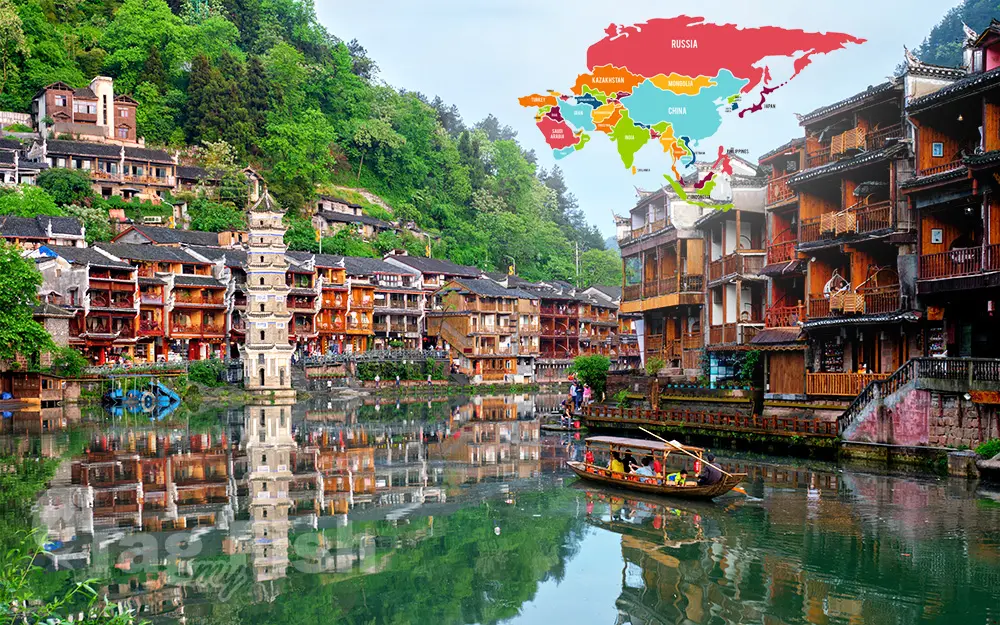
Asia is the largest and most populous continent on Earth, covering about 44.5 million square kilometers and accounting for nearly one third of the world's land area. It extends from the Arctic Ocean in the north to the Indian Ocean in the south, and from the eastern shores of the Mediterranean region to the vast waters of the Pacific Ocean. The continent contains an enormous variety of landscapes, including high mountain ranges, extensive plains, deserts, forests, and some of the largest and most important freshwater systems in the world.
The geography of Asia is strongly shaped by surrounding oceans and seas. To the east lies the immense Pacific Ocean, which forms a long coastline from the Russian Far East to Southeast Asia and Indonesia. Many of the continent’s largest rivers, including the Yangtze, Amur, and Mekong, eventually drain into this ocean. To the south, Asia borders the warm waters of the Indian Ocean, which receives the flow of major rivers such as the Indus, Ganges, and Brahmaputra. The northern coastline faces the Arctic Ocean, where several great Siberian rivers including the Ob, Yenisei, and Lena discharge massive volumes of freshwater into polar seas.
Around the continent are numerous seas that form important marine environments and fishing grounds. Among the largest and most significant are the South China Sea, the East China Sea, the Sea of Japan, and the Yellow Sea, all of which are part of the western Pacific region. Other important bodies of water include the Arabian Sea between India and the Arabian Peninsula, the Andaman Sea in Southeast Asia, the cold Sea of Okhotsk in the northwest Pacific, and the Bering Sea connecting the Pacific and Arctic regions. The Caspian Sea, located between Europe and Asia, is technically the world’s largest inland lake, though it is traditionally called a sea due to its immense size and slightly saline water.
Asia contains several of the largest lakes on the planet. The Caspian Sea, covering about 371,000 square kilometers, is the largest enclosed body of water on Earth. The remarkable Lake Baikal in Siberia is the deepest lake in the world and holds roughly 20 percent of the world’s unfrozen freshwater. Other large lakes include Lake Balkhash in Kazakhstan, the historically vast but now heavily reduced Aral Sea in Central Asia, and the large mountain lake Issyk-Kul in Kyrgyzstan. These lakes support unique ecosystems and are important regional water resources.
The river systems of Asia are among the longest and most influential in the world. The Yangtze River, stretching about 6,300 kilometers, is the longest river in Asia and the third longest on Earth. It flows entirely within China and drains into the East China Sea near Shanghai. The Yellow River or Huang He is another major Chinese river and is historically known as the cradle of Chinese civilization. In Southeast Asia, the Mekong River flows through several countries including China, Laos, Thailand, Cambodia, and Vietnam, forming one of the richest freshwater fisheries in the world.
South Asia is dominated by the enormous river systems of the Ganges, Brahmaputra, and Indus. These rivers originate in the Himalayas and provide water to hundreds of millions of people. The Ganges and Brahmaputra combine in Bangladesh to form one of the largest river deltas on Earth before reaching the Bay of Bengal. In northern Asia, the great Siberian rivers—the Ob, Yenisei, and Lena—flow across vast territories before emptying into the Arctic Ocean. Another important river is the Amur, which forms part of the border between Russia and China and eventually drains into the Sea of Okhotsk.
These oceans, seas, lakes, and rivers play a fundamental role in shaping Asia’s geography, climate, ecosystems, and human societies. Many of the continent’s major civilizations developed along river valleys, and today these waterways continue to support transportation, agriculture, fisheries, and freshwater supply. Because of their immense ecological and economic importance, the aquatic systems of Asia remain central to the environmental and geographic identity of the continent.
Asia is home to several of the largest freshwater fish species in the world, many of which inhabit the great river systems of the continent such as the Mekong, Yangtze, Ganges, and Irrawaddy. These rivers provide the vast habitats and abundant food sources necessary for giant freshwater fish to grow to remarkable sizes.
Among the most famous species is the giant freshwater stingray (Urogymnus polylepis), which can reach more than 2 meters in width and weigh over 600 kilograms, making it one of the heaviest freshwater fish ever recorded. Another iconic species is the Mekong giant catfish (Pangasianodon gigas), a massive migratory fish that can grow to about 3 meters in length and weigh more than 300 kilograms. The giant barb (Catlocarpio siamensis), the largest carp species in the world, also inhabits the Mekong basin and can exceed 3 meters in length.
Other notable large freshwater fishes in Asia include the Kaluga sturgeon (Huso dauricus) of the Amur River basin, the powerful goonch catfish (Bagarius yarrelli) found in Himalayan rivers, and the Chinese paddlefish (Psephurus gladius), a giant Yangtze River species that is now considered extinct. These impressive fish illustrate the extraordinary biodiversity of Asian freshwater ecosystems.
Many of Asia’s largest freshwater fish are now threatened by overfishing, dam construction, habitat loss, and river fragmentation. As a result, conservation efforts are increasingly important to protect these remarkable species and the river systems that support them.